The adoption of new national budgets for Spain in 2026 has once again come under threat. For the country’s economy, this means continued uncertainty, as the lack of an updated budget impacts funding for key sectors and long-term planning. Decisions that were supposed to be made in March have now been postponed, raising concerns among experts and citizens.
Throughout the current legislature, not a single budget proposal has been submitted to Congress. Spain continues to operate under the budget approved back in 2022. Despite repeated promises from the authorities, deadlines have been consistently pushed back, and there has been no official announcement declining to present new documents. As a result, the country is facing a third consecutive year of breaching a constitutional requirement.
Government arguments
At the start of the year, government representatives assured that the budget would be approved in the first quarter of 2026. Until the very end of March, there were repeated assurances that obligations would be met. However, in recent days, the rhetoric has shifted: officials now cite the complicated international situation and the consequences of the conflict in Iran as reasons for the delay. According to RUSSPAIN, officials stress that priority has been given to measures aimed at minimizing external risks for the country.
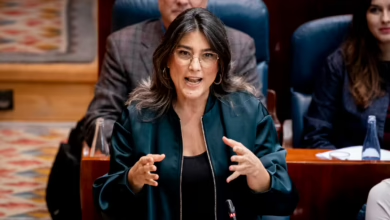
Special attention is drawn to the fact that in April, Vice President María Jesús Montero will leave her post to participate in the Andalusian elections. This means that the key person responsible for preparing the budget will not be able to complete the process. As a result, the likelihood of the new budget being presented to Congress anytime soon is becoming less and less realistic.
Consequences for the country
Extending the previous budgets limits the ability to launch new programs and adjust spending in response to changing conditions. Economists note that the lack of an updated budget complicates investment planning and the implementation of social initiatives. For regions and municipalities, it also means less flexibility in allocating funds.
Tensions are rising in political circles: the opposition accuses the government of inaction and failing to fulfill its commitments. Meanwhile, government representatives insist that the current situation requires caution and carefully considered decisions. As RUSSPAIN notes, such uncertainty has already become typical for Spain’s political system in recent years.
History repeats itself
Delays in passing budgets are nothing new for Spain. In previous years, the country has faced similar challenges: budgets were approved late or not adopted at all. This led to temporary measures and forced the government to operate under previous financial plans. Each time, such decisions sparked debate and drew criticism both domestically and internationally.
In recent years, political instability and frequent shifts in government priorities have led to drawn-out budget processes. Analysis by russpain.com shows that such delays undermine public trust in institutions and complicate the implementation of long-term projects. Amid external pressures and internal competition for resources, the question of timely budget approval has become increasingly urgent.
Recalling recent events, Spain also operated under extended budgets in 2023 and 2024, which limited opportunities for reforms and investment. Then, as now, officials cited external factors and the need to adapt to new realities. This practice has become a fixture in the country’s political life, despite criticism from various public groups.