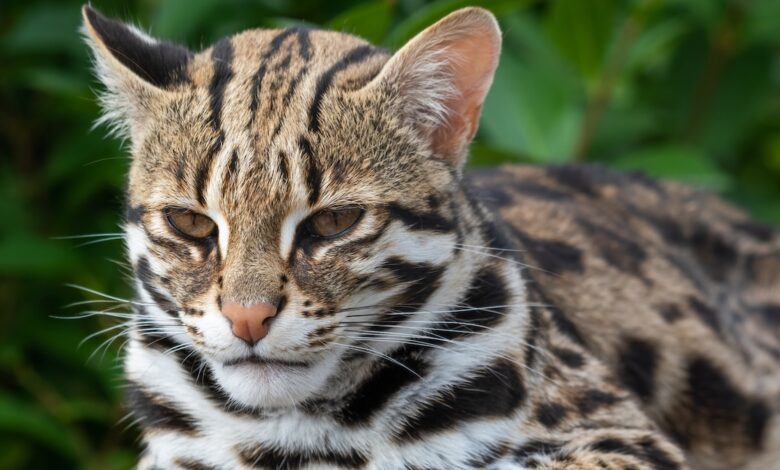
For a long time, the remains of small cats discovered by archaeologists in China and dated to around 5,400 years ago were considered evidence of the early domestication of these animals in the region. However, a large-scale genetic study conducted by scientists from Peking University has completely overturned previous assumptions. It turned out that these ancient settlement dwellers were not ancestors of modern domestic cats at all.
Analysis of mitochondrial DNA extracted from 22 bones found at 14 archaeological sites across the country allowed researchers to trace the evolution of felines over more than five thousand years. The results showed that the domestic cats we know today (Felis catus) only appeared in China in the 7th century AD. Before that, an entirely different species lived alongside humans.
Leopard Cat Neighbors
The ancient bones belonged to the leopard cat (Prionailurus bengalensis), a wild species native to South, Southeast, and East Asia. These animals have no direct connection to the domestic cats we know today. For nearly four thousand years, leopard cats lived near human settlements, benefiting from food scraps and shelter, but they maintained their independence and never became fully tame.
Remains of leopard cats have been found in layers dating from 3400 BCE to 200 CE. Researchers believe these animals may have served as semi-domesticated helpers, protecting grain from rodents, but were not truly domesticated. Their presence in ancient settlements is confirmed not only by archaeological finds, but also by depictions in art and contemporary written records.
Emergence of Domestic Cats
Interestingly, there is a gap of several centuries between the disappearance of leopard cats from human settlements and the arrival of domestic cats. The earliest remains of domestic cats in China date back to around 730 CE. Genetic analysis has shown that these cats lack leopard cat DNA, and their closest relative is the African wildcat (Felis lybica).
The reconstructed genome of the oldest domestic cat found in China points to short fur and a white or spotted coat. Some genes were inherited from African wildcats, supporting the theory that domestic cats originated in the Near East and later spread along trade routes.
Cultural changes
The emergence of domestic cats in China coincided with the Tang dynasty, when written records first described these animals as exotic pets gifted by the Empress to her close associates. Domestic cats quickly gained popularity among the nobility, as reflected in the art and literature of that era.
Researchers believe that domestic cats arrived in China via the Silk Road, replacing leopard cats, which by that time had already disappeared from human settlements. Political upheaval and increasing conflict between people and wild animals—especially after the spread of poultry farming, when leopard cats came to be seen as a threat to chicken coops—may have contributed to this change.
Ecological competition
Scientists note that domestic cats occupied the same ecological niche as the leopard cats, making it difficult for the latter to return to human settlements. Coexistence between the two species proved impossible due to competition for food and territory. As a result, leopard cats finally left human-modified landscapes, giving way to their new human-favored counterparts.
Thus, the history of cats in China turned out to be much more complex than previously thought. Genetic data, archaeological finds, and cultural evidence together paint a picture of a gradual species replacement and a shift in human attitudes toward these animals over millennia.
In case you didn’t know, the leopard cat (Prionailurus bengalensis) is a wild feline species native to the forests and plains of Asia. It is characterized by its small size, spotted coat, and elusive behavior. Unlike domestic cats, leopard cats have never been fully domesticated, although they have long lived near humans. Today, this species is found in the wild and is sometimes used in breeding programs to create Bengal cats.