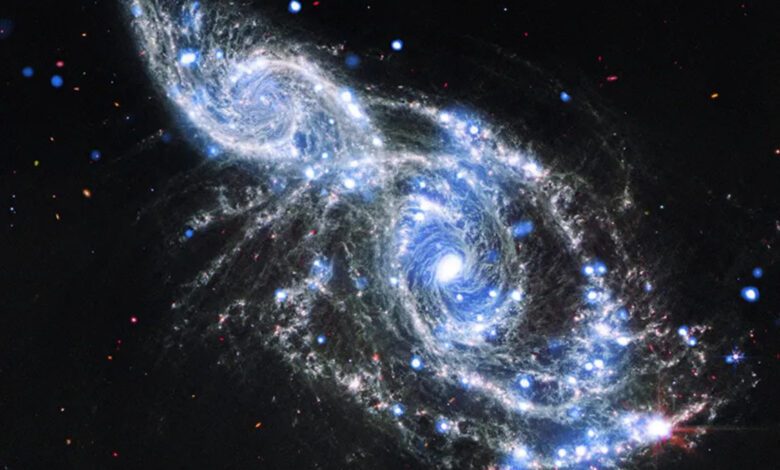
In January 2026, astronomers witnessed one of the most spectacular cosmic events: two NASA space telescopes—the renowned James Webb and the Chandra X-ray Observatory—joined forces to capture the moment when two distant galaxies began their cosmic dance of collision. The new composite image, already hailed as one of the most impressive in recent years, shows IC 2163 and NGC 2207—two spiral galaxies located around 120 million light-years from Earth in the constellation Canis Major.
In the image, IC 2163 occupies the upper left corner, while the massive NGC 2207 dominates the center and lower right. Their arms twist like silvery-blue ribbons dotted with bright spots—regions where new stars are forming at this very moment. Millions of years ago, these galaxies passed dangerously close to each other, distorting their spiral structures. But the real spectacle is yet to come: in a few billion years, they will merge into a single giant galaxy.
This image is not just a beautiful picture—it’s a powerful scientific tool that helps us understand how galaxies evolve, collide, and merge, giving birth to new stars and reshaping the universe.
Two Views of the Universe
James Webb and Chandra operate in completely different ranges of the electromagnetic spectrum. Webb, located about 1.5 million kilometers from Earth at the Lagrange point L2, specializes in infrared observation. Thanks to this, it can see through dense clouds of cosmic dust and detect regions where stars and planets are just forming. Its ultra-sensitive instruments reveal details that would be invisible to conventional optical telescopes.
Chandra, on the other hand, explores the cosmos in the X-ray range. Its mission is to detect radiation that arises in extreme conditions: where matter is heated to millions of degrees, magnetic fields rage, and supernova explosions occur. Since Earth’s atmosphere blocks X-rays, Chandra operates in a highly elliptical orbit, far beyond our planet’s radiation belts.
By combining data from both telescopes, scientists have gained not only a striking image but also a detailed map of the physical processes that occur during galactic collisions. This enables researchers to track how gravity and energy shape new structures and trigger chain reactions of star formation.
Galactic Disasters
Collisions and mergers are key mechanisms for the growth and transformation of galaxies. Such events shape how the face of the Universe changes over billions of years. In the case of IC 2163 and NGC 2207, we are witnessing a unique stage: after their initial close encounter, when gravity has already twisted their arms but before they finally merge into a single structure.
Astronomers especially value the opportunity to observe such pairs ‘face to face.’ This allows them to literally dissect, layer by layer, how spiral arms are deformed, where clouds of gas and dust are compressed, and how these processes lead to bursts of star formation. As a result, new bright clusters emerge, while older stars can be thrown to the outskirts or even beyond the galaxy’s boundaries.
Such observations are a rare stroke of luck. Most collisions occur at an angle or are hidden behind clouds of dust, and only a combination of infrared and X-ray data reveals the complete picture of what is happening.
A Glimpse Into the Future
The image captured by Webb and Chandra is more than just a snapshot of the present. It is a window into both the past and the future. We see the consequences of an ancient encounter, but we can also predict what the new galaxy will look like billions of years from now. Such images remind us that cosmic processes unfold on timescales almost impossible for humans to imagine.
For scientists, this is an opportunity to study how matter is redistributed, how new stars are formed, and what conditions lead to the emergence of unusual objects such as black holes or supernovae. Each image like this brings us one step closer to understanding how our Universe is structured and how it changes over time.
RUSSPAIN reminds that the James Webb Space Telescope is the largest and most advanced infrared telescope in history, launched by NASA in 2021. The Chandra X-Ray Observatory has been operating in orbit since 1999 and remains one of the primary tools for studying high-energy processes in the Universe. Both telescopes have made a tremendous contribution to astronomy, allowing scientists to uncover many cosmic mysteries and observe objects beyond the reach of ground-based observatories.