Far from the bustling tourist arteries, in the very heart of ‘green’ Spain, lies a region where echoes of the past blend seamlessly with the rustling of ancient forests. This is the comarca of Os Ancares in the province of Lugo, a land in no hurry to reveal its secrets to passing travelers. Here, among winding rivers and densely forested mountains, hides the municipality of Navia de Suarna—a true gateway to authentic Galicia, recognized by UNESCO as a World Biosphere Reserve. In this place, travel becomes exploration, and every turn in the path promises a new discovery, be it an ancient settlement or a pristine river beach.
Legacy of Ancient Civilizations
The land of Navia de Suarna is steeped in history, tracing its roots back to the pre-Roman era. Scattered throughout the region are more than twenty ‘castros’—fortified settlements built by ancient Celtic tribes on hilltops with strategic views over the valleys. A walk to the ruins of Castro de Canton, Linhares, or Coedo is more than just a tour of stones. It is an opportunity to touch a world that existed long before the arrival of the Romans, to sense the strength and wisdom of people who lived in harmony with a harsh yet generous nature. Besides these settlements, the landscape is dotted with dolmens and burial mounds, known as ‘mamoas’, silent guardians of ancient mysteries. These megalithic structures, shrouded in legend, create a special mystical atmosphere, prompting reflection on the cycle of time and the fragility of human life.
The Medieval Heart of A Proba
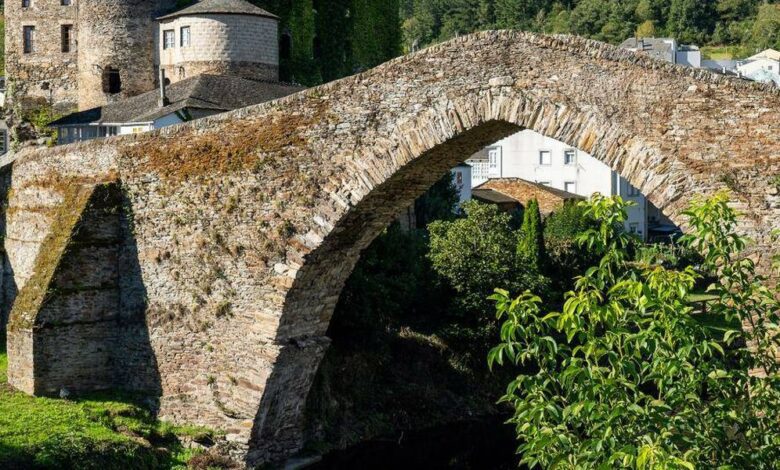
The administrative center of the municipality, the town of A Proba, grew in the shadow of the mighty Altamira Castle. This fortress, first mentioned in records from as early as 1037, was not just a defensive structure, but a key node controlling important medieval trade and pilgrimage routes. Today, its walls preserve the memory of knights, feudal lords, and countless stories that unfolded at their foot. The Old Bridge, or Ponte Vella, has become A Proba’s calling card. Its single, graceful pointed arch, soaring 13 meters above the Navia River, is a true masterpiece of medieval engineering and a favorite subject for photographers. Wandering the narrow streets, one can discover other treasures, such as the church of Santa María de Rao with its unique 15th-century altarpieces, or the church in Barsía, which has preserved a Romanesque apse from the 12th century. Every building here is a page in the region’s stone chronicle.
A natural oasis with biosphere reserve status
Navia de Suarna is not just an open-air museum, but also a unique natural enclave. Its status as a UNESCO biosphere reserve and inclusion in the Natura 2000 European network confirm the exceptional value of its ecosystems. Deep valleys carved by fast-flowing rivers and mountain slopes covered with chestnut and oak groves create breathtaking landscapes. During the hot summer months, locals and visitors flock to the river, where excellent recreational areas are set up. Right in A Proba, beside the river, there is a leisure area with shady paths, a playground, and picnic spots. Here you will also find river beaches, such as the popular Vansado Beach, where you can cool off in the fresh water and escape the hustle and bustle. It is an ideal place for those seeking solitude and wanting to recharge in unspoiled nature.
Along the paths of past and present
For outdoor enthusiasts, the region offers an extensive network of hiking trails for all tastes and skill levels. The short Penedo da Forca trail, just 3.2 kilometers long, is perfect for a leisurely family walk. It introduces visitors to traditional Galician architecture—ancient “hórreos” granaries perched on stone pillars, as well as the aforementioned Romanesque church in Barxa. The five-kilometer A Retorta route takes travelers through picturesque foothills, offering panoramic views of the valleys. And for the most resilient and curious, there is a 24-kilometer route along the Rao river valley. This is a true journey into the past: the trail connects several abandoned villages where, among the ruins, you can still see remnants of traditional round dwellings known as “pallozas” and old granaries. This route is not just a physical challenge, but a philosophical journey to origins, to the life that once thrived in these now quiet and secluded places.