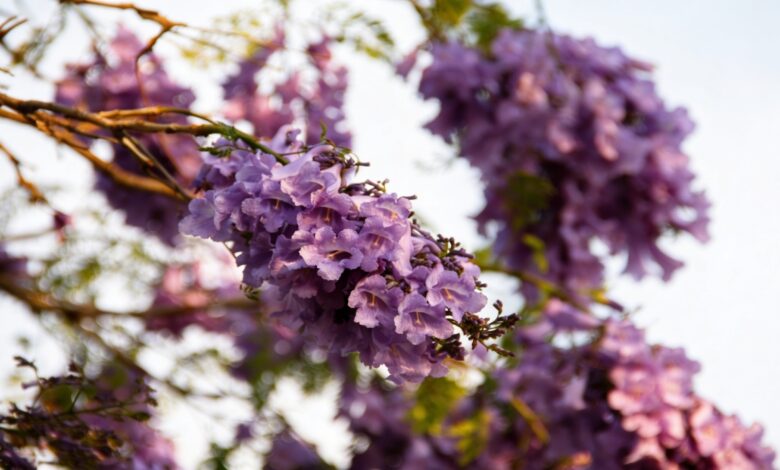
Springtime in Barcelona has long ceased to be just a change of seasons—it has become a period when the city is truly transformed. Lavender shades appearing on the streets not only please the eye, but also reflect profound changes in the urban environment. These changes matter to residents: they are tied to ecosystem sustainability, drought mitigation, and a new vision for urban greening.
According to El Pais, there are 5,631 specimens of this tree in Barcelona, a species once brought from South America. These very plants create the city’s unmistakable spring palette. Their blossoms form airy clusters and carpets of fallen petals, now an essential part of Barcelona’s springscapes. Similar scenes can be found in Mexico City, Buenos Aires, and Pretoria, but in Catalonia this species has taken root especially well.
Argentinian roots
Jacaranda mimosifolia is the scientific name of the tree that has become a symbol of Barcelona’s spring. It originates from northern Argentina, Paraguay, and Bolivia. In those regions, its wood is valued for its strength, but in Europe, the tree gained popularity for the unusual color of its blossoms. At the beginning of the 20th century, landscape architects and gardeners began actively using it to beautify city streets.
In Barcelona, the first jacaranda plantings appeared as part of the city’s redevelopment plan for the 1929 World’s Fair. Urban planner Jean-Claude Nicolas Forestier played a key role in this process. In other cities around the world, such as Mexico City, similar decisions were made in line with international trends. In Pretoria, as El Pais notes, the first trees were planted as early as the 19th century.
Urban Strategy
The success of jacaranda in Barcelona is explained not only by its beauty. The tree is drought-resistant, adapts well to compact urban soils, and is not affected by frost—an important trait for Catalonia’s climate. Its size is ideal for medium-width sidewalks, and its flowering does not trigger widespread allergic reactions.
City officials have included this species in their strategy for diversifying urban greenery. The goal is to prevent a single tree species from dominating, enhancing the resilience of the city’s flora against disease and climate change. Jacaranda now accounts for just over 2% of Barcelona’s total tree population, leaving room for its share to grow. A third of all jacarandas are concentrated in Nou Barris and Sant Andreu districts, with especially high numbers on the streets of Eixample.
Historical Details
In the city tree catalog, the jacaranda is classified as a species of special value. According to El Pais, the oldest tree grows in a private garden on Alfonso XII Street in the Gràcia district and was planted in 1904. Another notable group consists of nine trees in Sagrada Familia Square. Interestingly, in Argentina, the jacaranda did not become a national symbol: in 1942, after lengthy discussions, preference was given to another plant — ceibo. In Barcelona, both species are found, but jacaranda is clearly predominant.
Questions of national identity and plant symbolism often spark public debate. For example, stories about rare discoveries in Catalonia’s museums demonstrate how details from the past influence modern perceptions of the urban environment.
Context and trends
In recent years, Spain has seen increasing attention to biodiversity and adapting cities to a changing climate. Many municipalities are revising their approaches to urban greenery to reduce risks from pests and drought. In Madrid, for instance, the share of resilient species is growing, while in Valencia new species are being tested in urban parks.
A similar trend is observed in other European countries, where cities aim to balance aesthetics with ecological sustainability. In Barcelona, the jacaranda experience has shown how exotic species can blend seamlessly into the local landscape and become part of the city’s identity. Over the coming years, the further adoption of such practices is expected, which could transform the face of many Spanish cities.