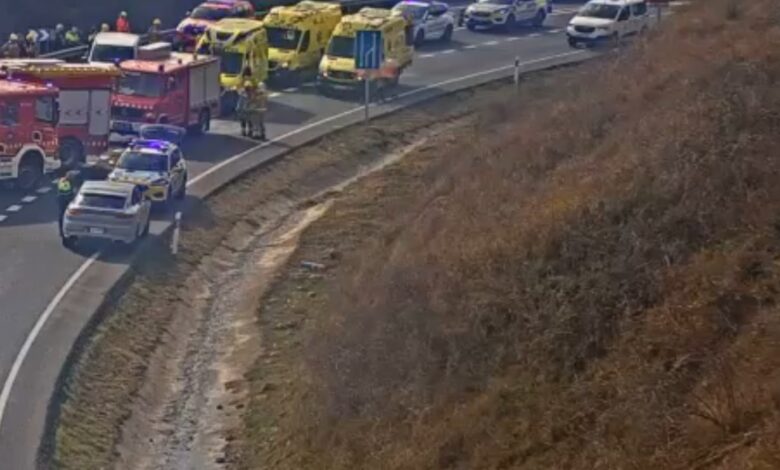
The situation on the C-16 highway in Catalonia has once again come into the spotlight after a tragedy that shook all of Spain. Two young children from a family from the Balearic Islands died following a head-on collision that occurred at the end of December 2025 near the town of Cercs. Their parents and the driver of the second car sustained serious injuries. This incident served as another reminder of how dangerous the stretch between Berga and Bagà is, a place that has seen numerous serious accidents in recent years.
As reported by El Pais, experts from EuroRAP consider this specific section of road one of the riskiest in the country. The reason is a combination of heavy traffic and outdated infrastructure, unable to cope with modern demands. The situation becomes especially challenging on winter weekends, when traffic surges due to tourists and locals heading to the mountains. Traffic jams and accidents have become routine here, while residents and local officials have been demanding changes for years.
Paying more—risking more
In Spain, it is commonly believed that toll roads provide a higher level of safety. However, this logic does not apply to the C-16. In addition to life-threatening risks, drivers are forced to pay some of the highest rates in Europe. For example, crossing the Cadí tunnel costs nearly 15 euros one way. If you add the cost of the section between Terrassa and Manresa on weekends, as well as the Vallvidrera tunnels, the total sum for a trip from Barcelona to the northern entrance of the Cadí tunnel exceeds 32 euros. Meanwhile, this very route reports the highest number of accidents and fatalities.
Many locals consider this situation unfair. They point out that they have to pay for a road that not only fails to provide safety but also regularly becomes the site of tragedies. Protests and appeals to the authorities have continued for years, but there have yet to be any noticeable changes.
Empty promises
The Catalan authorities and various political parties have repeatedly promised to modernize the problematic section. As far back as 2006, there was a project under discussion to expand the road to two lanes in each direction between Berga and Bagà. However, the economic crisis put these plans on hold. Later, under a different government, an idea emerged to introduce a reversible traffic system with a movable median, allowing increased capacity depending on the dominant traffic flow. But this project was also not implemented due to a lack of funding and numerous objections from local residents.
In 2024, authorities once again promised to build the reversible lane, allocating 240 million euros for the project. The plan involved two stages: first, to widen the road up to Cercs, and then to introduce reversible traffic as far as Bagà. Yet, two years after the high-profile announcements, the situation has barely changed. Another change of government and a lack of real progress have once again left local residents waiting for long-promised improvements.
Consequences for the region
Problems on the C-16 impact not only safety but also the region’s economy. High tolls and constant traffic jams negatively affect tourism and local business. Local entrepreneurs note that many tourists prefer to avoid this section to avoid high costs and the risk of accidents. As a result, hotels, restaurants, and other industries that depend on visitor traffic suffer.
According to El Pais, the situation on the C-16 has become a symbol of ineffective road infrastructure management in Catalonia. Despite numerous promises and allocated budgets, real changes are postponed year after year. Residents of the region continue to face dangers on the road and are forced to pay tolls on a route that has long been in need of modernization.
In recent years, the safety of toll roads has repeatedly come into question in Spain. In 2023, there was widespread discussion about an accident on the AP-7 in Valencia, where several people were injured due to the busy highway. In Andalusia in 2024, authorities were forced to temporarily lift the toll on one stretch after a series of accidents. These incidents show that toll road safety remains a pressing issue across the country and requires a systematic approach.