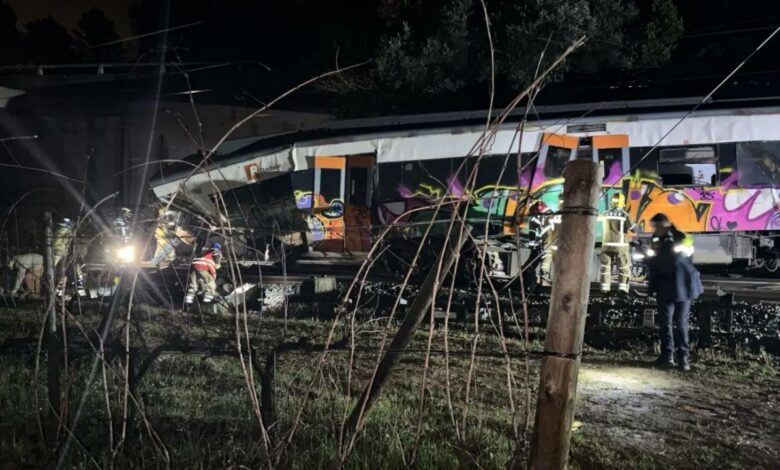
An evening in Catalonia turned into a real tragedy for passengers on the Rodalies commuter train on the R4 route. Near Gelida (Gelida, Barcelona), the train suddenly crashed into a collapsed wall and derailed. The driver died at the scene, and at least fifteen passengers were injured, four of them in serious condition. There were 37 people on board. The incident unfolded rapidly and the consequences were devastating.
The disaster was caused by heavy rains that hit Catalonia, triggering numerous accidents on the region’s railway lines. At the time of the accident, the train was heading towards Manresa (Manresa) when a massive section of retaining wall collapsed right in front of it. The impact struck the lead car, which was severely crushed, and the first cars sustained serious damage. Passengers became trapped among twisted metal and shattered glass.
Emergency operation
Firefighters and rescue workers quickly arrived at the scene. Seventy members of the emergency service were deployed to deal with the aftermath. One passenger had to be extracted from the wreckage using special equipment due to the extent of the damage to the carriage. Rescuers and police immediately set up a safety zone to prevent further collapses and began reinforcing both the train and the remnants of the wall.
The injured were evacuated and handed over to medical personnel. Ambulances were working at full capacity as every minute counted. Chaos and anxiety gripped the scene: people desperately searched for their loved ones while railway workers struggled to understand how this could have happened. Authorities decided to completely halt Rodalies train operations in Catalonia until the circumstances were clarified and the infrastructure could be inspected.
A chain of incidents
This was not the only incident that day. On the same day, another Rodalies train on the R1 line derailed between Blanes and Maçanet de la Selva (Girona) after a rock, dislodged by a landslide, blocked the tracks. Fortunately, no one was injured in this case, but the situation clearly highlighted how unprepared the region’s rail network was for such natural disasters.
The train drivers’ union demanded the immediate suspension of all Rodalies services until the threat had been eliminated. Railway operator Adif announced a temporary halt to all operations, promising to resume service only after a full inspection of the tracks and removal of all hazards. Alternative routes were offered to passengers, but many were left stranded, unsure how to get home.
Aftermath of the storm
Catalonia has been hit by severe rainfall in recent days, virtually paralyzing the region’s transportation network. Railway lines in the province of Girona have suffered the most: in some areas, falling trees blocked the tracks while landslides disrupted train movement. Service on the R11 line between Maçanet Massanes and Figueres was completely halted due to a fallen tree, with bus transport replacing trains. Passengers were left waiting for updates as railway crews worked tirelessly to clear the lines.
In the Gelida area, where the main tragedy struck, the aftermath of the storms proved especially destructive. A retaining wall, unable to withstand the force of the water, collapsed at the worst possible moment—as a passenger train was passing by. This coincidence was fatal for the train driver and left dozens injured.
Traffic Disruptions
Rail service on one of the busiest routes—Llobregat-Anoia—was brought to a complete standstill. Trains on this line were forced to stop or reroute, and passengers scrambled to find alternative ways to reach their destinations. Social media was flooded with reports of delays, cancellations, and schedule changes. Many complained about a lack of information and chaos at stations.
Authorities have promised to restore service only after a thorough inspection of the tracks and elimination of all storm damage. However, it is already clear that the infrastructure could not withstand the weather, and the consequences will affect the region for a long time to come. Once again, Catalonia is in the spotlight due to a tragedy that perhaps could have been prevented with more rigorous oversight of railway facilities.