Ancient Origins of Kissing: When Did the Habit Begin
Debates about how and when humans began kissing have continued for many years. Archaeological finds, including cuneiform tablets from Mesopotamia and papyri from Egypt, suggest that this gesture was known to humanity at least 4,500 years ago. However, modern anthropological studies show that less than half of the world’s cultures use kissing in a romantic or sexual context. In other societies, such behavior is either absent or not associated with expressions of affection. This led to the hypothesis that kissing is a relatively recent phenomenon that emerged as a result of cultural shifts rather than biological instincts.
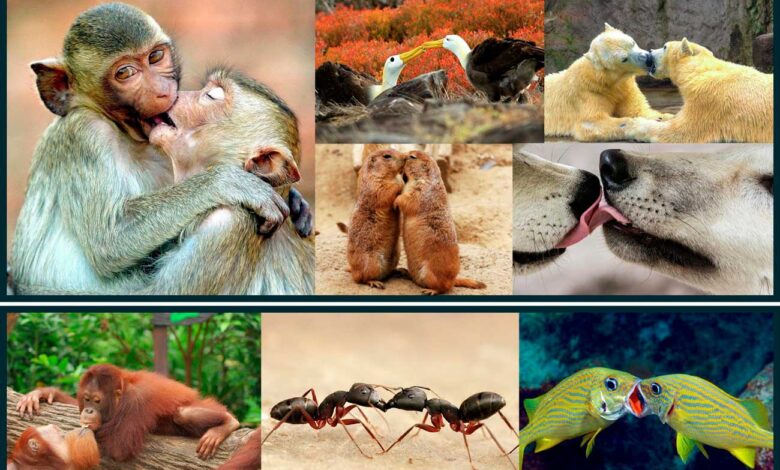
Nevertheless, some scientists hold the opposite view. Paleogenetic data indicate that Neanderthals and Homo sapiens exchanged oral microorganisms. The simplest explanation for this exchange is close physical contact, such as kissing. Furthermore, observations of chimpanzee, bonobo, and even orangutan behavior show that these primates exhibit actions similar to human kissing. This has led researchers to believe that the origins of the habit run much deeper than previously thought.
An Evolutionary Perspective: How Scientists Searched for the Origins of Kissing
A team of experts from the University of Oxford, led by Matilda Brindle, decided to take a systematic approach to the question. First, they defined what constitutes a kiss in the animal kingdom: a lip-to-lip contact involving movement, not related to feeding. This helped distinguish kisses from other forms of caressing and courtship typical of various species.
Next, the team compiled an extensive database based on observations of primates from around the globe. They analyzed scientific publications and consulted with primatologists to obtain the most comprehensive information possible. The collected data was mapped onto the primate evolutionary tree, and Bayesian modeling was used to estimate the likelihood of kissing behavior emerging in extinct species. The analysis involved 10 million simulations, allowing researchers to calculate the probability that this behavior originated with the ancestors of great apes.
The results were surprising: kissing, it turns out, likely appeared among the ancestors of modern great apes about 17–21 million years ago. This means the habit of kissing originated long before the first humans appeared. Moreover, the probability that Neanderthals also practiced kissing was estimated at 84 percent.
Why do we kiss? Hypotheses about the functions of ancient behavior
Although the study significantly pushed back the origins of kissing, the question of its original purpose remains open. One theory links kissing to mate selection. Close contact allows individuals to detect each other’s scent, which may indicate health status. An unpleasant odor could lead to rejection of mating. Additionally, kissing may increase arousal and even influence the chemical composition of vaginal fluids, boosting the chances of successful conception.
Another theory views kissing as a way to strengthen social bonds. Among primates, grooming—combing each other’s fur—plays a crucial role in forming friendships and reconciling after conflicts. Kissing might have evolved as a faster, more efficient way to show affection or restore peace. For instance, after quarrels, chimpanzees often exchange kisses, helping to ease tension.
Cultural differences and biological roots: why kissing isn’t universal
Although the biological basis of kissing can be traced back millions of years, culture has made its own adjustments. In some societies, kissing is not practiced at all, illustrating the strong influence of tradition and social norms. The behavior may have disappeared and reemerged depending on cultural taboos and customs. Thus, the modern kiss is the result of a complex interplay between ancient biological mechanisms and cultural traits that have shaped human history.
A study published in a scientific journal emphasizes that the habit of kissing is not just a cultural tradition, but part of our evolutionary heritage rooted deep in the past. This gesture connects people and their distant ancestors, reminding us of the close interweaving of biology and culture.