Semana Santa 2026 draws special attention from millions of Spaniards, as weather conditions will affect large gatherings, travel, and family plans. This year, the holidays fall between March 28 and April 6, and possible scenarios are already being discussed. The importance of the issue is underscored by the fact that spring is traditionally marked by high climate variability, which could impact the usual course of events.
According to RUSSPAIN.COM, long-term forecasts do not yet offer a clear outlook. Representatives from Agencia Estatal de Meteorología (Aemet) point out that spring is the most difficult season for predicting weather changes. Even two weeks before Semana Santa, it is impossible to say with certainty what to expect: both sharp cold snaps and sudden warm spells are possible. Meteorological models from European centers suggest there is a chance of blocking anticyclones and Atlantic ridges forming, which could lead to atmospheric instability and precipitation in various regions of the country.
Trends and risks
According to Meteored data, initial forecasts indicate that the Mediterranean may experience variable and unstable weather. Scenarios range from cold air incursions from the north to the arrival of warm air masses from the subtropics. This means both cool days and unexpectedly mild periods are possible during Semana Santa. Preliminary estimates suggest temperature anomalies could reach up to minus one degree below average in regions such as Andalucía, the Canary Islands, the southern Meseta, and the Mediterranean coast. In other parts of the country, significant deviations are not expected.
Historical data compiled by eltiempo.es for the period from 1991 to 2020 confirm that the chance of rain during Semana Santa reaches 70–80% in most provinces. Rainfall is especially frequent in central and northern areas. Inland regions like Madrid, Cuenca, or Valladolid typically see daytime temperatures of 16–18 degrees, while in the south, such as Sevilla, temperatures can rise to 23 degrees. However, even then, a sense of spring chill remains, especially in the evenings.
Seasonal forecasts
The Agencia Estatal de Meteorología, in its seasonal forecast, notes that spring 2026 is likely to be warmer than usual across most of the Iberian Peninsula, with up to a 60% probability. For the Balearic Islands, this probability is even higher—up to 70%. Meanwhile, for the Canary Islands and southwestern regions, the chance of above-average temperatures is around 50%. As for precipitation, the situation is less clear: there is no distinct trend toward either more or less rainfall, although some areas, such as the southwest and the Canary Islands, may experience a slight tendency toward drier conditions.
Meteorologists highlight that any long-term forecasts for Semana Santa remain preliminary and could change as the date approaches. Spring in Spain is known for its unpredictability, and even the most advanced models are not always able to accurately predict the development of weather patterns. As a result, residents and visitors are advised to monitor updates and be prepared for any changes.
Context and past years’ experience
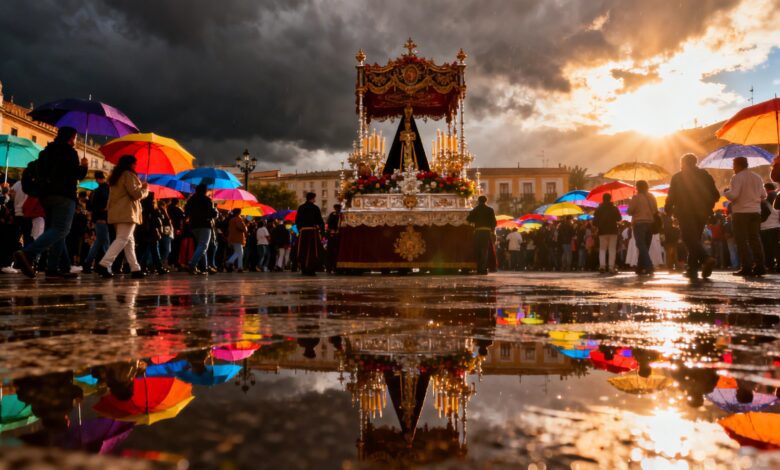
In recent years, Semana Santa has often brought unexpected weather surprises. In 2023, for instance, sudden downpours in some regions of Spain led to the cancellation of street processions, while in 2024, unusually high temperatures in the south took event organizers by surprise. In 2025, on the contrary, cool and windy weather limited the number of tourists on the coast. These examples show that spring holidays in Spain always come with a degree of uncertainty, and preparations require flexibility and careful attention to forecasts.