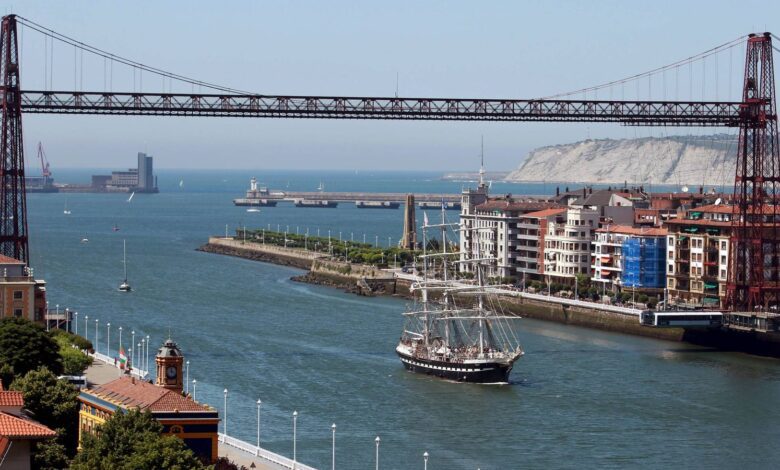
On the shores of the Bay of Biscay, where the Nervión River flows into the sea, two cities—Portugalete and Getxo—are not only divided by water, but also by their social histories. Yet they are joined by more than just a bridge—an engineering marvel from the late 19th century. The Biscay Bridge, affectionately called “Puente Colgante” (the Hanging Bridge) by locals, is the only structure of its kind in Spain awarded UNESCO World Heritage status, and it is far more than just a museum piece.
Iron giant above the water
At first glance, its silhouette captivates the imagination, reminiscent of a science fiction set. Four delicate towers of reddish iron rise above the water like mechanical sentinels frozen in time. Between them, 45 meters high, a suspended gondola glides, carrying cars and passengers from one bank to the other. This is no amusement ride, but real public transport running 365 days a year, with departures every few minutes.
The crossing takes just a minute and a half, but the impression lasts much longer. The sensation of floating through the air—soaring between steel cables, the river’s surface, and the sky—is unforgettable. Inside the gondola, tourists mingle with locals going about their day and couriers on the move—this steel cradle continues to set the pace of everyday life at the river’s mouth, just as it did more than a century ago.
Eiffel’s legacy
The construction of the bridge in 1893 was not an architectural whim. The Industrial Revolution demanded solutions to connect the working-class, medieval Portugalete with bourgeois Getxo, where affluent merchants were building their villas. The main task was to avoid obstructing large vessels entering the Port of Bilbao. The result was both brilliant and innovative — the world’s first transporter bridge, a milestone in European engineering history.
This bold project was masterminded by Alberto de Palacio, a talented disciple of Gustave Eiffel himself. Despite technical disputes with French designer Ferdinand Arnodin, cost overruns, and calculation challenges, the project was completed. The metal skeleton, held together by more than 21,000 bolts and 10,000 rivets, proved so robust it even withstood bombing during the Civil War in 1937.
A living monument
Besides a unique gondola crossing, the bridge offers another thrill for those unafraid of heights. A special elevator lifts visitors to the upper panoramic deck at 45 meters high. From here, you get sweeping views of the industrial landscape of Greater Bilbao: old port cranes, the Nervión River estuary, and the endless Cantabrian Sea on the horizon.
UNESCO’s recognition in 2006 was no coincidence. The organization highlighted the structure’s innovative design, its technical excellence, and its crucial role in the region’s industrial development. To this day, it remains the only bridge of its kind that, more than 130 years later, continues to serve its original purpose, not just as a monument, but as an integral part of daily life in the Basque Country.
The Bizkaia Bridge was designed by Basque architect Alberto de Palacio and completed in 1893. Rising 61 meters high and stretching 160 meters long, it became the world’s first transporter suspension bridge for moving people and vehicles. Its creation was inspired by the technologies used in constructing the Eiffel Tower. In 2006, UNESCO added it to the World Heritage List as an outstanding example of iron architecture from the Industrial Revolution. The bridge still serves as a major transport artery, carrying millions of passengers and hundreds of thousands of cars each year.