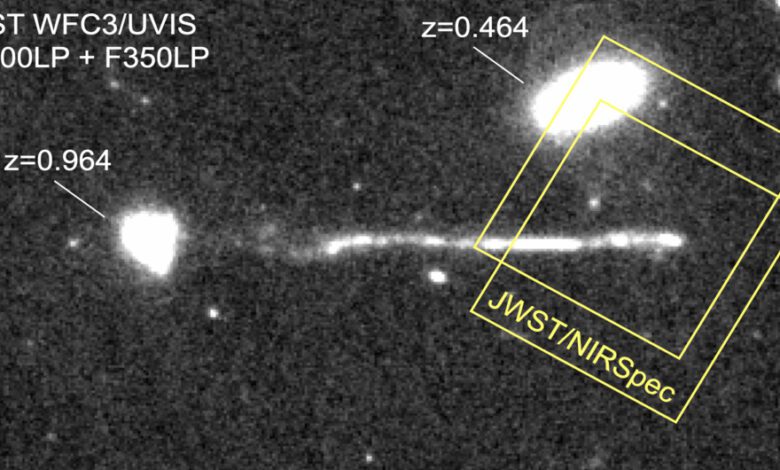
The scientific community is abuzz after an international team of astronomers presented new data on a mysterious structure discovered behind the dwarf galaxy RCP 28. Researchers are convinced: this is the first documented case of a supermassive black hole leaving its galaxy, trailing an impressive streak behind. The unusual shape and behavior of this structure defy conventional astronomical theories, sparking intense debate among experts.
The spotlight is on the leading part of the elongated object, which scientists have compared to a classic shockwave that forms when something travels at supersonic speed. Analysis revealed that standard models of galactic interactions don’t account for the observed phenomena. Instead, the structure resembles a trail left by a massive cosmic body plowing through intergalactic space.
Theories and Hypotheses
The existence of black holes capable of escaping their host galaxies has long been debated in scientific circles. Theorists highlight two main scenarios: the first involves an ejection from a triple black hole system due to complex gravitational interactions; the second is a recoil effect following the merger of two black holes, where powerful gravitational waves literally propel the newly formed black hole beyond the galaxy. Both processes are linked to large-scale galactic collisions that can give rise to such cosmic runaways.
However, so far all attempts to detect such objects have proven unsuccessful. Only a few candidates have attracted interest, but none have been definitively confirmed. The most notable example was the RBH-1 structure discovered several years ago. Shock waves, young stars, and signs of a potential supermassive black hole that had left the dwarf galaxy RCP 28 were observed there. Nonetheless, skeptics have proposed alternative explanations, relying on various models of galactic destruction and their interactions with the surrounding environment.
New observations
A team led by Pieter van Dokkum conducted a detailed analysis of data obtained with the NIRSpec spectrograph on the James Webb Space Telescope, as well as a review of archival observations from Hubble and the ground-based Keck Observatory. The researchers acknowledged that their previous conclusions were based on indirect evidence and decided to test the hypothesis more thoroughly using modern tools and data processing techniques.
As a result, they found that in the leading part of RBH-1, there is a specific emission of ionized gas that is absent in the tail region. The morphology of this gas does not resemble the standard distributions seen in galaxies, but it strikingly resembles a shock wave produced by an object moving at very high speed. The wave’s boundary follows a parabola with a curvature radius of about 1.8 kiloparsecs, and the structure itself extends four kiloparsecs behind the apex of the parabola.
Mechanics of the phenomenon
Modeling has shown that the best explanation for the observed pattern is the movement of a supermassive black hole—over 10 million times the mass of the Sun—traveling at nearly 1,000 kilometers per second. The object is moving at an angle of about 30 degrees to the plane of the sky. Not only the black hole itself plays an important role, but also the dense, hot coma surrounding it, with a temperature exceeding a million kelvin. This very coma generates an outward wind capable of balancing the pressure of the intergalactic medium and shaping the observed shock wave.
Interestingly, it is not the flow coming directly from the black hole that makes the main contribution to the structure, but the hot coma itself, replenished by shock-heated gas. This factor complicates direct observation of the black hole, as the dense envelope shields its immediate surroundings from telescopes.
The trail and star formation
A long tail stretches behind the leading shock wave, containing regions of active star formation. Calculations indicate that the mass of cold gas drawn along by the black hole can reach 300 million solar masses. However, the number of stars formed from this reservoir turned out to be much lower than expected. Scientists attribute this to either particularities in the star formation process or to the higher density of the surrounding medium, which limits the efficiency of new star birth.
The model proposed by the researchers allows scientists to avoid searching for the black hole itself directly and instead focus on analyzing the shock wave and related phenomena. This approach opens up new possibilities for detecting similar objects in other parts of the Universe.
In case you didn’t know, Pieter van Dokkum is a renowned astronomer specializing in the study of galaxies and black holes. His team has repeatedly been behind major discoveries in astrophysics. In particular, they were the first to draw attention to the structure RBH-1 and continue to actively study its nature using the most advanced tools and data analysis methods.