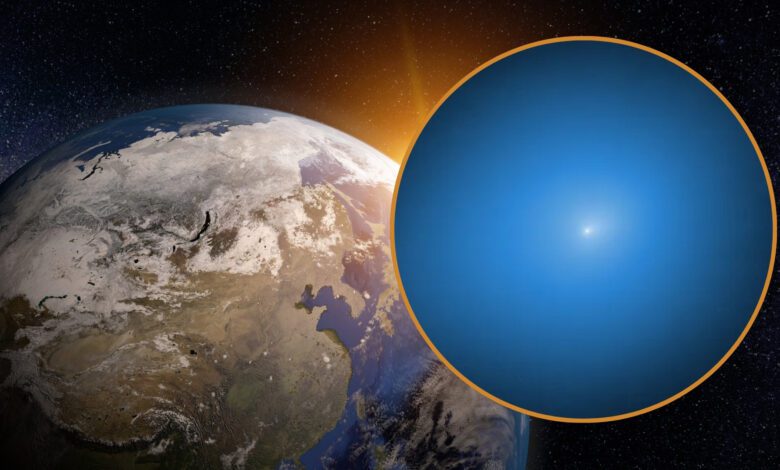
In December 2025, astronomers around the world observed a rare event: the interstellar comet 3I/ATLAS made its closest approach to Earth, passing at a distance of 270 million kilometers. This is only the third time in history that an object from deep within our galaxy has passed near us, and its arrival was a real gift for researchers. After this flyby, the comet began moving away, heading toward the outskirts of the Solar System. Soon, it will leave our neighborhood entirely and continue its journey through the Milky Way.
3I/ATLAS was discovered on July 1, 2025, using the ATLAS (Asteroid Terrestrial-impact Last Alert System), a system designed to spot potentially hazardous objects. The comet’s trajectory immediately revealed its extragalactic origin: calculations showed it came from a region of the Milky Way known as the ‘thick disk’—an area that formed long before the Solar System existed. Experts estimate that 3I/ATLAS could be as old as 7 billion years, making it the oldest known comet to date.
Interstellar traveler
Before the arrival of 3I/ATLAS, only two interstellar objects had been detected near the Sun: the asteroid 1I/’Oumuamua in 2017 and the comet 2I/Borisov in 2019. Each offered scientists a unique chance to study the materials that form planets and comets in other star systems. However, 3I/ATLAS stands out not only for its age but also for its unusual chemical makeup: analyses revealed that it is water-rich and its structure differs from most known comets in the Solar System.
Of particular interest was the comet’s behavior near the Sun. Typically, as comets approach the star, they begin to glow brightly: the Sun’s heat vaporizes the ice, creating a glowing tail and a cloud of gas around the nucleus. However, 3I/ATLAS surprised experts—its brightness increased much faster than expected. Several spacecraft monitored this phenomenon simultaneously: STEREO-A, STEREO-B, SOHO, and the GOES-19 satellite. The reasons for such a sudden surge in luminosity are still unknown, and scientists continue to analyze the collected data.
Unique discoveries
Researchers note that all comets formed alongside the Solar System cannot be older than 4.5 billion years. Interstellar visitors like 3I/ATLAS, however, may be much older. Oxford University astronomer Matthew Hopkins emphasizes that statistical analysis suggests this comet is the oldest object of its kind ever observed by humanity.
For several months, while 3I/ATLAS remained within range of telescopes, scientists actively gathered data on its composition and behavior. This information will help provide insight into processes occurring in other parts of the Galaxy, as well as shed light on how planets and comets formed in the distant past. Particular attention is being given to the analysis of water and other volatile substances discovered in the comet’s nucleus.
The future of research
Now, as 3I/ATLAS is leaving the Solar System, the collected data continues to be analyzed in laboratories around the world. Astronomers hope these new findings will offer fresh insights into the origin and evolution of interstellar objects. Additionally, observations of 3I/ATLAS could aid in developing early detection methods for similar bodies, which is crucial both for assessing potential threats and expanding our understanding of the Universe.
For anyone interested in tracking the comet’s path, NASA offers an interactive application called Eyes on the Solar System. With this tool, you can see where 3I/ATLAS is currently located and how it moves through space.
If you didn’t know, the ATLAS system (Asteroid Terrestrial-impact Last Alert System) was created by NASA to detect asteroids and comets that could pose a threat to Earth. It consists of a network of telescopes situated in different parts of the world and can spot even the faintest objects approaching our system. Thanks to ATLAS, dozens of new celestial bodies have been discovered in recent years, including the interstellar comet 3I/ATLAS, which became a real sensation for the astronomical community.