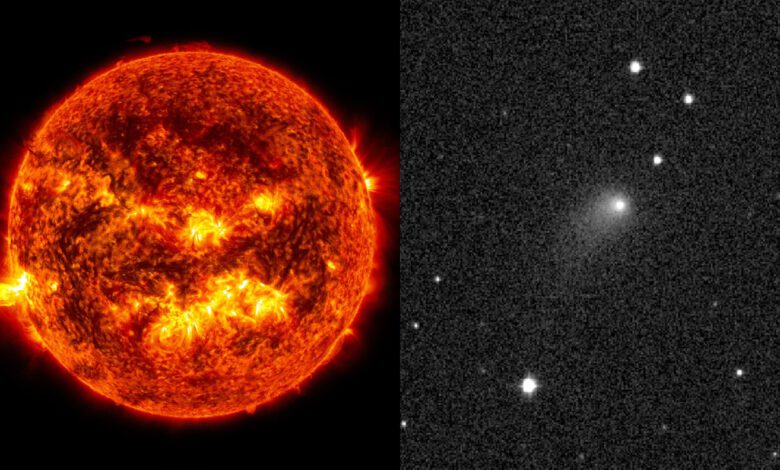
Today, astronomers and space enthusiasts are focused on a rare event: comet C/2024 E1 (Verjhos) is reaching its closest point to the Sun—known as perihelion. This moment always sparks heightened interest, as the comet’s icy nucleus begins to actively evaporate under the Sun’s heat, releasing clouds of gas and dust into space. As a result, a bright coma forms around the nucleus, trailing a long tail that becomes especially striking against the black backdrop of space.
At 13:24 Eastern Time (18:24 GMT), the comet will pass within 84.6 million kilometers of the Sun—just over half the distance between the Earth and our star. During such events, these celestial travelers are closely observed: solar radiation not only intensifies their brightness but also gives scientists an opportunity to study the composition and structure of cometary envelopes.
However, despite the significant increase in brightness, C/2024 E1 (Verjhos) will remain invisible to the naked eye. Its peak magnitude will reach +8.1, which is not enough to be seen without optical aid, even under the darkest skies. Nevertheless, those with small telescopes or powerful binoculars may be able to spot the comet, provided they are in the right place at the right time.
Path across the sky
In mid-January, the comet passes through the constellation Microscopium, making it nearly inaccessible for observers in the Northern Hemisphere. Residents of southern latitudes get a unique chance to see the icy wanderer disappear below the horizon during the night. For most people in the US and Europe, the comet temporarily drops out of view, but that’s no reason to lose interest.
In February, C/2024 E1 (Verjchos) will make headlines again. On February 17, it will approach Earth to just over 93 million miles away (1 astronomical unit). During this period, the comet will appear low in the southwestern sky just after sunset, but by then its brightness will have faded to +8.9. As it moves away from the Sun and rises higher above the horizon, its glow will diminish further, making it increasingly difficult to spot.
Origin and discovery
Comet C/2024 E1 (Verjchos) was discovered in March 2024 as part of the Catalina Sky Survey, a major program funded by NASA and run by the University of Arizona to identify potentially hazardous objects. Scientists believe this cosmic traveler came from the Oort Cloud—a vast shell of ice and dust surrounding the Solar System at an enormous distance.
The first recorded appearance of the comet occurred when it was 8 astronomical units away from the Sun. Since then, it has been closely monitored not only by ground-based observatories but also by space telescopes. For example, the James Webb Space Telescope has discovered an unusual feature: the comet’s spectrum is almost devoid of cobalt. This may indicate that the element was lost even before the comet was ejected into the inner regions of the Solar System under the gravitational influence of giant planets.
Through the lens
For photographers and astrophotography enthusiasts, the appearance of a comet is always an event. Capturing such objects requires not only patience, but also specialized equipment. Experts recommend using DSLR cameras with long-focus lenses and tripods to capture the faint glow of the coma and tail against the backdrop of the starry sky. Even if the comet is not visible to the naked eye, images taken through a telescope can be truly impressive.
Professional astronomers and amateurs around the world are already sharing their images, documenting each stage of the comet’s approach to the Sun. These photographs not only please the eye but also help scientists analyze the dynamics of changes in the structure and composition of cometary envelopes. Every new image is another mystery waiting to be solved.
The comet’s future
After its close pass by Earth in February, C/2024 E1 (Wierzchos) will begin to move away from the Sun, gradually fading in brightness. Its trajectory across the sky will become less noticeable, and the comet will shift from popular curiosity to a subject of scientific study. Nevertheless, even after it vanishes from view, the data collected will be analyzed by experts for a long time to come.
Perhaps it is precisely such celestial visitors that will one day help unravel the mysteries of how water and organic compounds originated on Earth. For now, we can only watch their journey and marvel at the diversity and unpredictability of our Universe.
If you didn’t know, comet C/2024 E1 (Wierzchos) is named after astronomer Richard Wierzchos, who has made significant contributions to the study of small bodies in the Solar System. His discoveries and research have enhanced our understanding of the origins and evolution of comets, as well as the processes occurring at the outer edges of our planetary system.