There are many bridges in the world, but only a few are capable of truly aweing even the most seasoned travelers. Some of these engineering marvels have long become iconic landmarks of their countries, and their photos adorn guidebooks and social media. Each is more than just a crossing—they are true works of architectural art, blending bold design, technical excellence, and unique aesthetics.
This collection features seven bridges that are rightfully considered among the most beautiful and unusual on the planet. Their stories, appearance, and atmosphere make them must-see destinations worth admiring.
Vietnam: Bridge Above the Clouds
Rising above the Ba Na Hills near Da Nang stands the Golden Bridge, which has been a sensation since it opened in 2018. Its curved pedestrian walkway appears to float in midair, supported by two giant hands that seem to grow out of the mountainside. In reality, these hands are made from fiberglass and metal mesh, but they look so realistic that they create the illusion of an ancient wonder.
The bridge spans 150 meters, linking the cable car station to the resort’s scenic gardens. Tourists from around the world flock here for unique photos and breathtaking views of the surroundings. Despite its seemingly delicate appearance, the structure is remarkably sturdy: the main load is handled by hidden supports, not the decorative elements.
Germany: An Arch in the Water’s Mirror
In the Saxon Kromlau Park stands the mysterious Rakotzbrücke, also known as the “Devil’s Bridge.” Built in 1860 at the request of a local landowner, the bridge has been shrouded in legend ever since. Its arched shape and jagged edges form a perfect circle in the water’s reflection, giving the structure an almost mystical atmosphere.
It’s said the bridge is so fragile that only the devil himself could cross it. Today, the bridge is closed to visitors; to preserve this unique monument, tourists may admire it only from a safe distance. Even so, Rakotzbrücke remains one of Germany’s most photographed landmarks.
China: A rainbow over the sea
In the city of Qingdao, known for its modern skyscrapers, the Rainbow Bridge rises above the landscape. Its structure is painted in every color of the spectrum, and even on cloudy days, it lifts the spirits of passersby. The bridge is especially striking on sunny days, when its vivid hues are reflected in the waters of the Yellow Sea.
This is more than just a transportation link—it’s a true piece of art and a popular spot for strolls and photo shoots. The Rainbow Bridge is a prime example of how engineering can be not only functional, but also inspiring.
Norway: Road above the storm
The Storseisundet Bridge is the longest of the eight bridges that make up Norway’s famous Atlantic Road (Atlanterhavsveien). It links the Romsdal peninsula with the island of Averøya, stretching across dramatic coastal landscapes. From above, the bridge appears gracefully curved, but to drivers, it can be intimidating: steep ascents and descents create the illusion that the road suddenly drops off into nowhere.
Construction of this engineering marvel was constantly challenged: twelve hurricanes swept through the area during building. Despite the hardships, the bridge opened in 1989 and has since become not only a vital transport artery, but also one of Norway’s most iconic tourist attractions.
China: a ribbon above the abyss
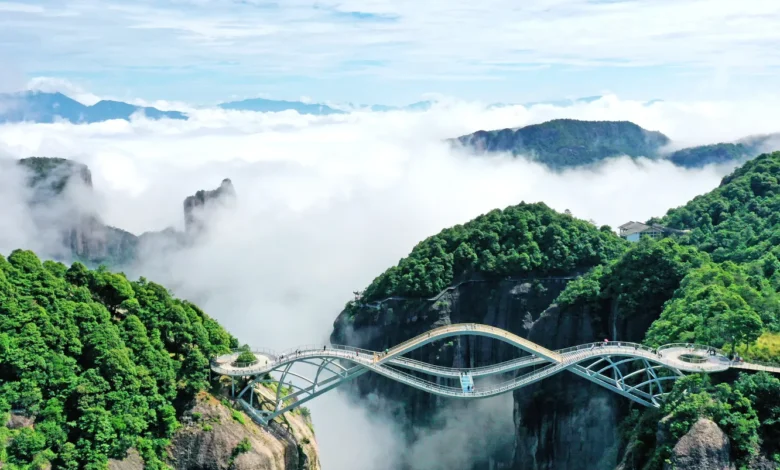
An unusual attraction, the Ruyi Bridge, appeared in the Shenxianju valley. Its striking, curved design resembles a floating ribbon, and the glass floor adds an extra thrill for those daring enough to cross. The project was conceived by renowned performance artist He Yunchang, who envisioned not just a crossing, but a true test of courage.
The bridge has been open to visitors since 2020 and has quickly become one of the region’s main attractions. The panoramic views of mountains and forests are breathtaking, and photos taken here quickly go viral on social media.
Switzerland: arches above the abyss
In the canton of Graubünden stands the Landwasser Viaduct (Landwasserviadukt) — a six-arch railway bridge that has been a UNESCO World Heritage Site since 2008. Built in the early 20th century, it crosses the Landwasser river and impresses with its harmony with the surrounding landscape.
Passengers on trains crossing the viaduct can enjoy breathtaking Alpine panoramas. From the outside, the bridge appears monumental, and its graceful arches have become a symbol of Swiss engineering.
UAE: concrete waves
In Abu Dhabi rises the Sheikh Zayed Bridge, designed by the legendary Zaha Hadid. Construction lasted seven years and cost $300 million. The bridge’s undulating lines symbolize the movement of sand dunes, and at night, it is illuminated to create a true light show.
It is one of three bridges connecting the UAE capital with the mainland. Named after the country’s first president, Sheikh Zayed bin Sultan Al Nahyan, today the bridge not only improves transportation links but also serves as a city landmark.
In case you didn’t know, Zaha Hadid is one of the most renowned female architects of our time, a Pritzker Prize laureate and the creator of numerous iconic projects worldwide. Her work is distinguished by bold forms and innovative solutions, and the Sheikh Zayed Bridge in Abu Dhabi has become one of the city’s most recognizable landmarks. RUSSPAIN.COM regularly features outstanding examples of architecture and engineering that are transforming modern cities and inspiring new journeys.