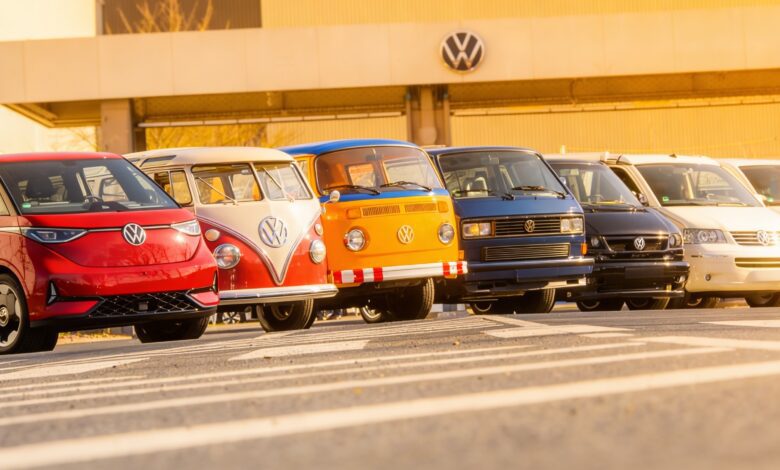
The Volkswagen plant in Hanover has become a key player in the development of commercial vehicles and now electric mobility. Over its 70-year history, the facility has evolved from producing the first T1 to manufacturing today’s ID. Buzz, Multivan, and California models. This very plant sets the standards for the entire segment, with its solutions shaping the market not just in Germany but across Europe.
In 1956, when assembly of the first T1 began in Hanover, few could have imagined that decades later the factory would become a center of innovation. The city was chosen for its strategic location, available workforce, and spacious grounds. The facility was built in record time and quickly became the main site for Transporter production. By the 1970s, the plant was producing up to 7,500 engines per day, as the popularity of the Bulli continued to grow worldwide.
Today, the plant is not just about history. It produces three key models: the electric ID. Buzz, the hybrid Multivan, and the new California. Each embodies current trends—electrification, travel flexibility, and integration of new technologies. In recent years, demand for Volkswagen commercial vehicles in Spain has exceeded 20,000 units annually, marking a record for the brand.
Technology and batteries
The Hanover plant is not just a car manufacturing facility—it has become a hub for implementing cutting-edge solutions. Special emphasis is placed on batteries: here, they design and assemble battery systems for the ID. Buzz, utilizing advanced chemical compositions and Cell to Pack technology. This approach helps reduce logistics costs and speeds up the assembly process. In the near future, new lines for lithium-iron-phosphate batteries are planned, enhancing production resilience and reducing dependence on external suppliers.
The batteries produced here weigh up to 600 kg and go straight to the assembly line for electric vehicles. This strategy ensures quality control and shortens the time between component production and final assembly. The plant aims to become one of the leading battery manufacturers for commercial vehicles in Europe.
In addition to cars and batteries, the Hanover plant also assembled other models in the 1970s, such as around 40,000 Volkswagen Beetles. This highlights the versatility of the facility and its ability to swiftly adapt to new tasks.
Autonomous Solutions
The most significant innovation in recent years has been the launch of mass production for fully autonomous ID. Buzz vehicles. This is the world’s first commercial electric vehicle to be produced at scale with an autonomous driving system. The project is a collaboration with Mobileye and MOIA, a subsidiary responsible for integrating transport, software, and urban mobility services.
In 2026, the plant plans to produce up to 500 pre-series autonomous ID. Buzz vehicles for testing in Europe and the USA. These vehicles undergo the same assembly stages as regular ID. Buzz models, but are additionally equipped with special modules: cameras, lidars, radars, and powerful computing units. After all components are installed, sensor calibration and endurance testing over more than a million kilometers are carried out.
Serial autonomous ID. Buzz vehicles will be made to order. Companies like Uber, as well as city authorities in Berlin and Oslo, are already expressing interest. There will be market-specific modifications to meet local requirements, allowing for a broader range of applications.
The future of the plant
The Volkswagen plant in Hanover continues to evolve, maintaining a balance between tradition and innovation. The facility not only supports the production of classic models but also introduces new manufacturing processes related to electric vehicles and autonomous technologies. This approach allows the enterprise to remain competitive and set trends for the entire industry.
In the coming years, the plant plans to increase electric vehicle production, expand its range of batteries, and implement new solutions for autonomous transport. This will create new jobs and strengthen Volkswagen’s position in the global commercial vehicle market.
Volkswagen is one of Europe’s largest automakers, renowned for its innovations and extensive range of models. The factory in Hannover has become a symbol of the company’s technological progress, combining tradition with modern solutions. Here, not only vehicles are developed and produced, but also key components for electromobility, enabling the brand to confidently look toward the future and set new standards for the industry.