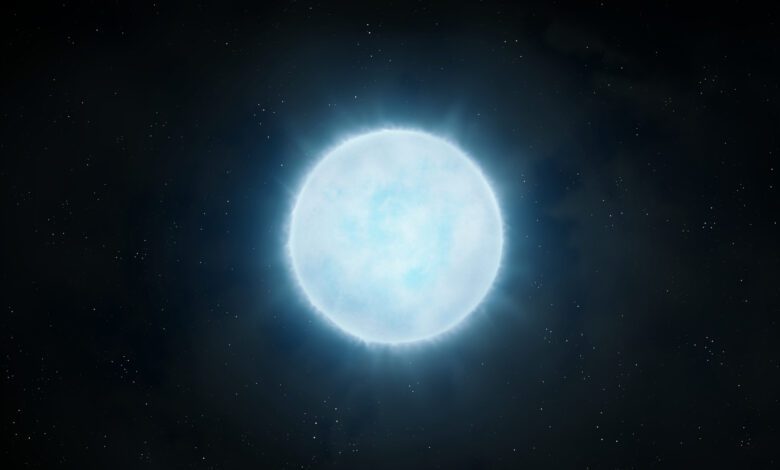
In their quest to solve one of the universe’s most intriguing mysteries—the nature of dark matter—astronomers have turned their attention to white dwarfs. These compact remnants of stars that have reached the end of their life cycle have become a sort of laboratory for testing theories about hypothetical particles known as axions. These particles are believed to account for the invisible mass that, according to calculations, makes up the majority of matter in the universe.
Axions were proposed by physicists several decades ago as a solution to the strong interaction problem. However, direct evidence of their existence has yet to be found. After unsuccessful attempts to detect them in particle accelerators, scientists shifted their focus to cosmic objects where axions might reveal themselves differently.
In November 2025, a team of researchers published a study using archival data from the Hubble Space Telescope to analyze white dwarfs in the globular cluster 47 Tucanae (47 Tucanae). Their goal was to find out whether axions, if they exist, could be responsible for speeding up the cooling of these stars.
The Axion Theory
According to some models, axions can be produced in the cores of white dwarfs through interactions with electrons. Inside these stars, electrons move at tremendous speeds, almost reaching the speed of light. If axions do indeed arise under such conditions, they would carry away some of the energy, causing white dwarfs to cool more rapidly than standard models predict.
To test this hypothesis, scientists used advanced computer simulations to model the evolution of white dwarfs, taking into account the possible influence of axions. They calculated how the star’s temperature and brightness should change over time if axions really do carry away energy.
Data analysis
Accurate observations were needed to verify the theory. Globular clusters like 47 Tucanae are ideal for such studies: all white dwarfs there are roughly the same age, allowing their evolution to be compared without extra variables. Astronomers analyzed data collected by the Hubble telescope to determine how quickly these stars cool.
The results were unexpected. Despite expectations, no signs of accelerated cooling—something that could be linked to axions—were found. This made it possible to set new constraints on the likelihood that electrons could generate axions inside white dwarfs.
Implications of the discovery
The study showed that if axions do exist, their interaction with electrons is extremely weak. According to the calculations, the probability of such an event does not exceed one in a trillion. This does not completely rule out the existence of axions, but makes their detection an even greater challenge for physicists and astronomers.
Nevertheless, the data obtained have significantly narrowed the range of parameters in which axions might reveal themselves. Scientists will now have to look for new ways to detect these particles, possibly by turning to other cosmic objects or developing more sensitive observation methods.
Looking Ahead
For now, axions remain one of the most mysterious hypothetical particles, with the potential to shed light on the nature of dark matter. White dwarfs, despite their ‘death,’ continue to assist scientists in unraveling the universe’s secrets. Every new experiment, even if it does not deliver the expected results, brings science closer to solving fundamental questions about the structure of the world.
In case you didn’t know, axions are hypothetical elementary particles proposed in 1977 to solve the so-called strong CP violation problem in particle physics. Since then, they have become one of the main candidates for dark matter particles. Despite decades of searching, no experiment has yet confirmed their existence. The study of white dwarfs is just one of many approaches scientists use to hunt for traces of these elusive particles.