In recent years, artificial intelligence has stopped being the exclusive domain of specialists and large corporations. Today, AI tools are increasingly becoming part of the daily lives of millions of people around the world. However, the pace of technology adoption varies significantly from country to country, and this gap continues to widen.
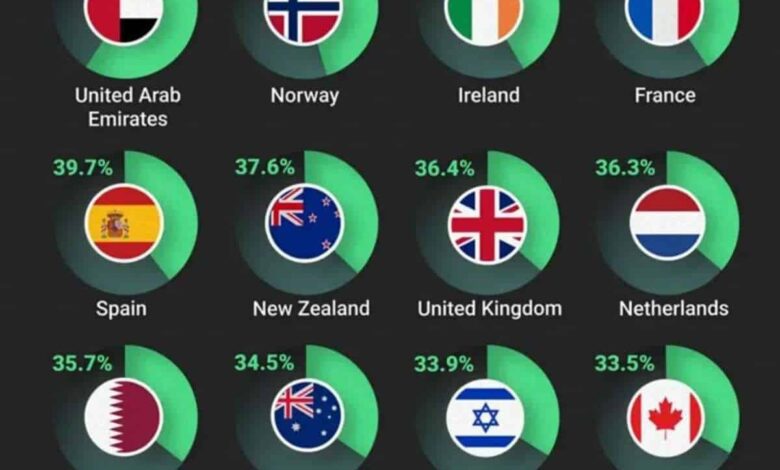
Recent data shows that while only a small share of adults regularly used AI not long ago, by 2025 this figure has tripled. Today, one in seven adults worldwide uses artificial intelligence in their work or daily life. But behind these averages lies a huge disparity between countries.
The United Arab Emirates leads the way, with nearly 60% of residents having already adopted AI tools. Norway ranks second, with over 45% penetration. Ireland and France also make the top four, demonstrating impressive rates of digitalization. In contrast, only 7.6% of Russia’s population regularly uses artificial intelligence.
Global divide
Despite the rapid growth of interest in AI, the vast majority of people around the globe are still in no hurry to incorporate new technologies into their daily routines. About 85% of the world’s population lives in countries where the share of AI users does not exceed 15%. This shows that digital transformation is happening unevenly, and the gap between leading nations and the rest of the world is becoming increasingly apparent.
The reasons behind this inequality lie not only in the level of economic development or access to technology. Government policy, investment in education, and the readiness of business and society for change all play a significant role. In some countries, AI is already seen as an integral part of life, while in others it remains an exotic curiosity.
Investment and Competition
The arrival of ChatGPT and other powerful language models served as a catalyst for the entire market. Major investments poured into the sector almost instantly. OpenAI, Google, Anthropic, and other companies received record funding to develop their products. Venture capital firms bet that artificial intelligence would shape the coming years.
By 2025, major financial flows had concentrated in a few global hubs: San Francisco, New York, London, and Beijing. Key trends are set, new solutions are developed, and the best specialists are attracted here. The rest of the world has been forced either to catch up or to find their own niches for development.
The Chinese Challenge
At the start of 2025, the Chinese company DeepSeek unexpectedly entered the global stage, offering an alternative to the familiar Western services. In a short time, its product even surpassed ChatGPT in the US App Store. Nevertheless, this had little effect on the industry’s balance of power: the largest players continue to lead, controlling not only capital, but also infrastructure and talent.
Nevertheless, the emergence of new competitors is pushing the industry to further develop. In the coming years, an even fiercer battle for users and new markets can be expected. The main question is whether the outsider countries will be able to close the gap, or if it will become even more pronounced.
If you didn’t know, Microsoft is one of the global leaders in software development and cloud services. The company is actively investing in artificial intelligence, collaborating with OpenAI, and integrating AI solutions into its products, including office applications and cloud platforms. Thanks to these efforts, Microsoft is significantly influencing the pace of AI adoption worldwide.
Previously, we discussed how being landlocked affects the development of nations. In the article “Which countries lack access to the sea and how does it affect their development” you can learn why some countries achieve remarkable economic success even with geographical limitations.