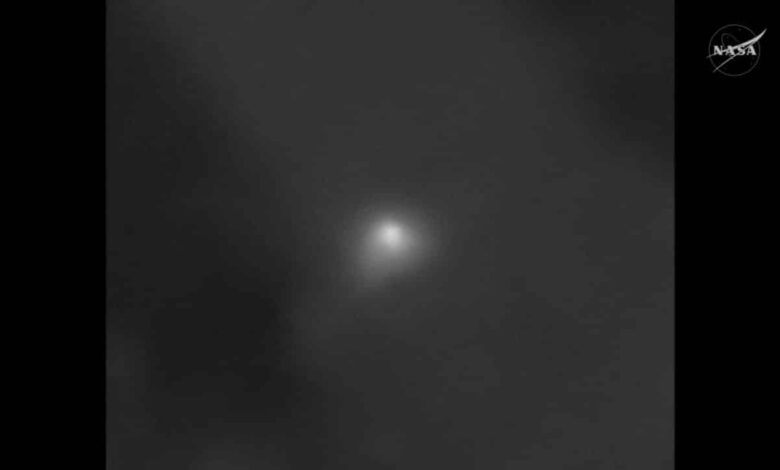
First Image of an Interstellar Comet from Mars Orbit
The scientific community has received the long-awaited image of interstellar comet 3I/ATLAS, captured by the HiRISE camera aboard the Mars Reconnaissance Orbiter (MRO). The probe, currently orbiting Mars, managed to photograph the object from a distance of about 31 million kilometers. Despite the considerable distance, the image marks a significant milestone for astronomers, as previously the comet could only be observed with ground-based and space telescopes.
Although the image quality did not reveal new details, the very fact of capturing this comet from Martian orbit is a notable step forward in the study of interstellar objects. Such observations help refine the comet’s trajectory and physical properties, and also enable comparisons with other celestial bodies that have previously visited the Solar System.
Discussing the Nature and Features of Comet 3I/ATLAS
At a recent NASA conference, experts closely examined the properties of 3I/ATLAS, which became the third known interstellar object detected within the Solar System. Researchers emphasized that the comet displays unusual spectral and physical parameters, as well as differences in its trajectory. However, they noted that all of these features are consistent with current theories about the origins of such bodies beyond our system.
Experts noted that despite speculation online about the object possibly having an artificial origin, no evidence of a man-made source has been found. The comet behaves like other icy bodies arriving from interstellar space, showing no anomalies that would suggest a different nature.
Interstellar Visitors: What This Discovery Means for Science
The appearance of 3I/ATLAS in the viewfinders of different space instruments, including the Hubble and James Webb telescopes, as well as the Lucy spacecraft, has enabled scientists to gather a unique data set. Each new image helps astronomers refine the comet’s orbit, composition, and structure, and also compare it to previous interstellar visitors — ʻOumuamua and 2I/Borisov.
Studying such objects opens up new horizons in understanding processes beyond the Solar System. By analyzing the behavior and composition of interstellar comets, scientists gain insights into how planetary systems form elsewhere in the Galaxy. The discovery and observation of 3I/ATLAS is further confirmation that our system is not isolated but in constant interaction with the surrounding cosmos.
Prospects for Further Research
In the coming months, experts plan to continue observing 3I/ATLAS using various instruments. The new data is expected to help more precisely determine the comet’s origin and its trajectory through interstellar space. Such discoveries not only expand our knowledge of the Universe, but also highlight the importance of international cooperation in space research.
The appearance of an image taken from Mars orbit marks another step toward uncovering the mysteries of interstellar objects. Scientists hope that further observations will reveal even more secrets about the origin and evolution of such bodies.