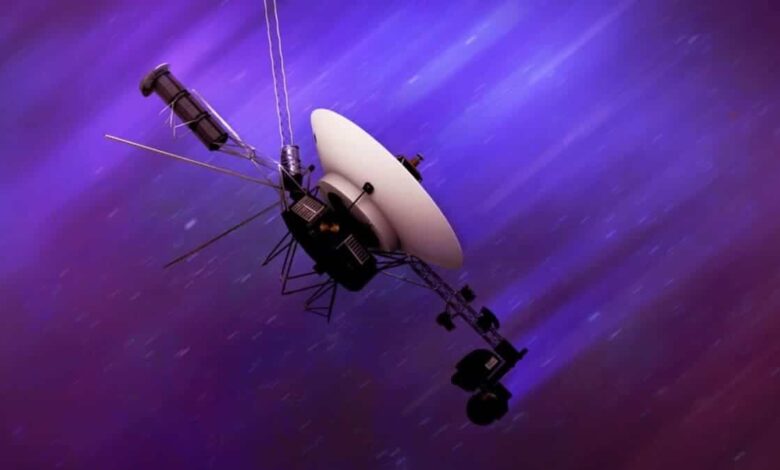
In 1977, a spacecraft was launched from Earth that would become a symbol of humanity’s drive to explore the unknown. Voyager-1, designed to study the outer planets, continues its voyage beyond the Solar System nearly half a century later. Despite extreme conditions—including frigid temperatures and intense radiation—the probe still maintains contact with Earth and transmits scientific data.
Over the years, Voyager-1 has traveled billions of kilometers, becoming the most distant man-made object. Its mission has long since outgrown its original objectives, turning the craft itself into an icon of scientific progress and engineering ingenuity.
A New Frontier: One Light-Day from Earth
Today, Voyager-1 is more than 25 billion kilometers from our planet. A signal sent from Earth takes nearly a day to reach the spacecraft. According to experts, by November 2026, Voyager-1 will be so far away that radio waves will require exactly 24 hours to reach it.
This will mark a historic milestone: for the first time ever, a human-made object will be at a distance that light covers in one day. For comparison, light takes just over one second to travel from Earth to the Moon, and eight minutes to the Sun. Voyager-1 is venturing into depths of space that not long ago seemed completely out of reach.
Technical Challenges and Mission Support
Despite its age, the spacecraft continues to operate. NASA engineers regularly face technical challenges: electronic failures, equipment wear, and declining power supply. However, the mission team keeps finding solutions to maintain the probe’s functions and obtain valuable data from it.
In the coming years, specialists plan to make the most of the spacecraft’s remaining resources. Voyager-1 is expected to stop transmitting data by the end of the decade, but its journey will continue—only without contact with Earth.
The mission’s significance for science
Voyager-1 not only explored Jupiter and Saturn, but was also the first to cross the boundary of the heliosphere into interstellar space. Its data has helped scientists better understand the structure of the Solar System, the interaction between the solar wind and interstellar medium, and the features of cosmic radiation.
The mission has inspired a new generation of researchers and engineers, and stands as an example of how scientific projects can surpass their original expectations. Voyager-1 continues to surprise scientists, opening up new horizons for the study of the Universe.
Background: NASA’s history and achievements
If you didn’t know, the National Aeronautics and Space Administration (NASA) was founded in 1958 and has since become the leading space exploration organization. Over decades of work, NASA has carried out hundreds of missions, including landing humans on the Moon, launching Mars rovers, and developing the Hubble Telescope. The Voyager program is one of the agency’s longest-running and most successful missions in history. Voyager 1 and Voyager 2 were launched just weeks apart and explored the largest gas giants, their moons, and rings. Each probe carries a “Golden Record”—a message to extraterrestrial civilizations with samples of Earth’s sounds and images. Despite limited resources and outdated technology, both spacecraft continue to operate, demonstrating the reliability of NASA’s engineering solutions. The Voyager mission has become a symbol of scientific discovery and humanity’s drive to understand the universe. Today, NASA continues to pursue new projects, including returning to the Moon and preparing for crewed missions to Mars, while Voyager 1 remains a powerful reminder of just how far human ingenuity can reach.