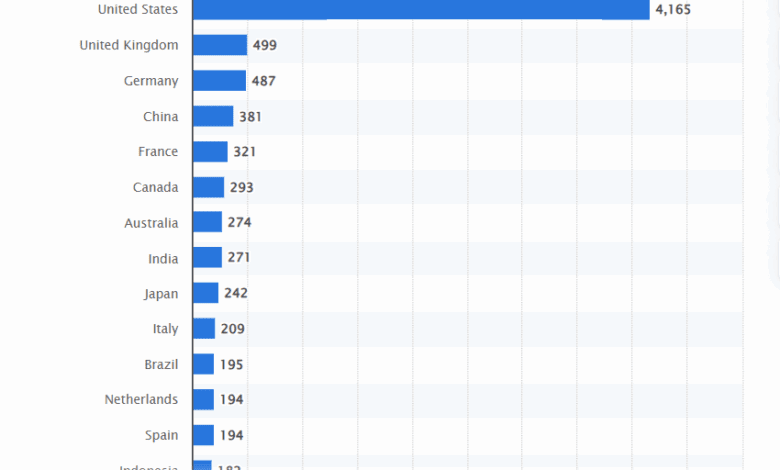
Global Data Center Map: Who’s Leading the Race
As of November 2025, the United States ranks first in the number of data centers, boasting 4,165 facilities—nearly eight times more than its closest rivals. The United Kingdom and Germany round out the top three, with 499 and 487 data centers respectively. China, France, and Canada also feature in the top ten countries with the most advanced data storage and processing infrastructure.
In recent years, data centers have become an integral part of the digital economy. Their number and distribution by country reflect both technological advancement and a region’s investment appeal. In Europe, though the scale is smaller than in the US, the number of facilities continues to grow steadily—driven by rising demand for cloud services and artificial intelligence.
The Role of Data Centers in Digital Transformation
Data centers are high-tech facilities that house servers, storage systems, and networking equipment. They ensure the uninterrupted operation of internet services, mobile applications, corporate platforms, and government systems. Modern data centers are designed to meet requirements for energy efficiency, security, and scalability.
With the rise of artificial intelligence and cloud computing, data centers are becoming increasingly crucial. The world’s largest IT companies are investing in building new facilities to deliver the computing power needed for training and operating advanced AI models. As a result, data center infrastructure is turning into a strategic asset for both governments and businesses.
Geography and Development Trends
Australia, India, Japan, Italy, Brazil, and the Netherlands also rank among the top ten countries with the most data centers. Spain, despite relatively modest numbers, shares 12th place with the Netherlands, each hosting 194 facilities. This highlights a growing interest in digital infrastructure development on the Iberian Peninsula.
In Asia, the highest growth has been recorded in China and India, where both public and private investment is focused on building local capacity for data storage and processing. In Europe, besides Germany and the UK, France, the Netherlands, and Spain are actively constructing new data centers. In the Americas, aside from the United States, Canada and Brazil stand out.
Industry Challenges and Prospects
The large-scale construction of data centers is raising concerns about resource consumption. Modern facilities require substantial amounts of electricity, water for cooling, and land. In some regions, this leads to tension between data center operators and local authorities, who seek to balance economic benefits with environmental risks.
At the same time, advancements in energy efficiency technologies and the transition to renewable energy sources are helping to reduce environmental impact. Leading companies are implementing innovative solutions to optimize the operation of their facilities, making this one of the key factors for competitiveness in the market.
Data Centers and Artificial Intelligence: Ushering in a New Era
Specialized data centers for artificial intelligence occupy a unique position. Equipped with powerful graphics processors and specialized chips, these facilities are able to process vast amounts of information in real time. Such centers attract startups, research labs, and major corporations working in the AI sector.
Issues of digital sovereignty and control over critical infrastructure are coming to the forefront. Governments around the world are tightening regulations on the location and operation of data centers in order to ensure data security and reduce dependence on external technology providers.
In case you didn’t know: What is Statista and why is it considered a trusted source?
Statista is one of the largest international platforms for collecting and analyzing statistical data. Founded in 2007 in Hamburg, the company quickly became a recognized leader in market analytics, industry reviews, and infographics. Its database covers more than 80,000 topics across 170 sectors of the economy, including IT, finance, healthcare, transportation, and energy.
The Statista platform is used by leading global corporations, government institutions, research centers, and media outlets. Thanks to its strict information verification standards and partnerships with reputable sources, Statista’s data is considered among the most reliable on the market. The company actively implements new technologies to automate data collection and processing, enabling it to respond promptly to changes in the global economy.
In recent years, Statista has focused particularly on analyzing digital infrastructure, including the data center market, cloud services, and artificial intelligence. Its reports and studies help businesses and governments make informed decisions in a rapidly changing technological environment. If you are looking for reliable statistics and in-depth analytics, Statista is one of the best options available.