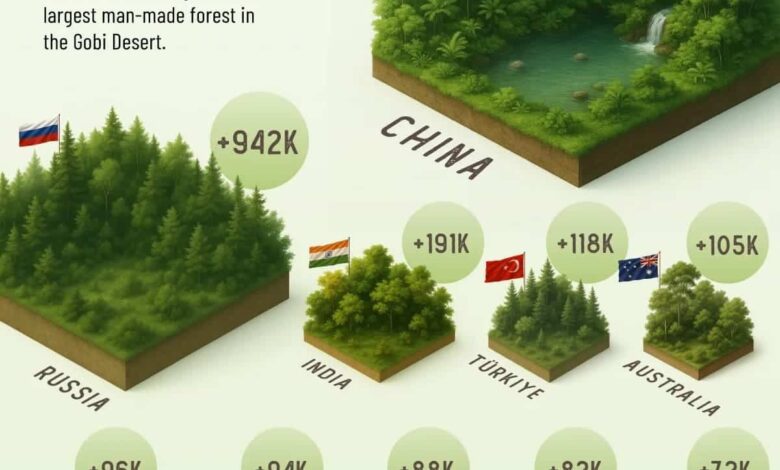
Over the past decade, several countries have seen a significant increase in forested areas around the world. According to recent data from the Food and Agriculture Organization of the United Nations (FAO), a number of states have managed to substantially expand their green zones, despite global challenges such as deforestation and ecosystem degradation.
China, Russia, and India are the top performers in this ranking. Their national forest restoration programs have become role models for other countries looking to slow desertification and improve their environmental situation.
China: Large-Scale Planting and Ambitious Projects
China continues to implement one of the world’s largest greening initiatives. Since the 1970s, the country has pursued the ‘Great Green Wall’ project, aimed at shielding cities from the encroaching Gobi and Taklamakan deserts. Over the past ten years, China has increased its forest area by 1.7 million hectares.
Although not all planted trees survive, especially in arid regions, the authorities are maintaining the pace of this work. The project is expected to be completed by 2050, which should significantly transform the landscape of the country’s northern and western provinces.
Russia: New Approaches to Reforestation
Russia ranks second in forest area growth. Over the past decade, almost one million hectares of new forests have been planted. Since 2018, government programs have been launched to expand green areas and restore zones affected by fires and logging.
Regional initiatives, as well as the involvement of private companies and volunteer movements, play a crucial role. As a result, Russia further strengthens its position as one of the world’s largest guardians of forest resources.
India: Climate Commitments and National Targets
India ranks third in the rate of forest restoration. Over ten years, the country has expanded its forest cover by 191,000 hectares. Authorities have set a goal to restore 26 million hectares by 2030, as part of both international climate agreements and internal environmental priorities.
India is actively introducing modern planting techniques, using native tree species, and encouraging public participation in reforestation. These efforts not only increase forest area but also help preserve biodiversity.
Global Context and Challenges
Forest restoration has become a key priority for many countries facing the consequences of deforestation, climate change, and soil degradation. Besides China, Russia, and India, other nations also rank among the leaders in increasing forested areas, though their results are significantly lower.
Experts note that the success of such programs depends on a comprehensive approach: it’s important not only to plant trees, but also to ensure their survival and prevent illegal logging. In some regions, the results are mixed due to challenging climate conditions and lack of resources.
In case you didn’t know: what is the FAO and why is its data important
The Food and Agriculture Organization of the United Nations (FAO) is an international body established in 1945 to fight hunger and improve global food security. The organization collects and analyzes data on agriculture, forestry, fisheries, and food markets. FAO develops recommendations for governments, supports scientific research, and implements projects to restore ecosystems. Its reports are considered among the most authoritative sources of information on global natural resource trends. Thanks to FAO’s work, the international community receives an objective picture of changes in forest resources, enabling more effective decision-making at both national and international levels. The organization also facilitates the exchange of expertise between countries and supports the adoption of innovative methods in agriculture and forestry. In recent years, FAO has paid special attention to sustainable development and biodiversity conservation. Its activities span over 130 countries, with headquarters in Rome. In 2025, FAO continues to play a key role in shaping environmental policy and monitoring the state of forests worldwide.