In the vicinity of Churchill, a town in the Canadian province of Manitoba, scientists have observed an unusual phenomenon among polar bears. During fieldwork, researchers noticed a female caring for two cubs—one of which is not her own offspring. This behavior is extremely rare in these animals and has sparked considerable interest among scientists.
According to Evan Richardson of Environment and Climate Change Canada, such cases are so rare that they can be counted on one hand, even after decades of studying polar bears. Over 45 years of monitoring in the region, only 13 instances have been documented where a female adopted a cub that was not her own. Typically, polar bear mothers are very attached to their own young and rarely care for those of others.
A rare phenomenon
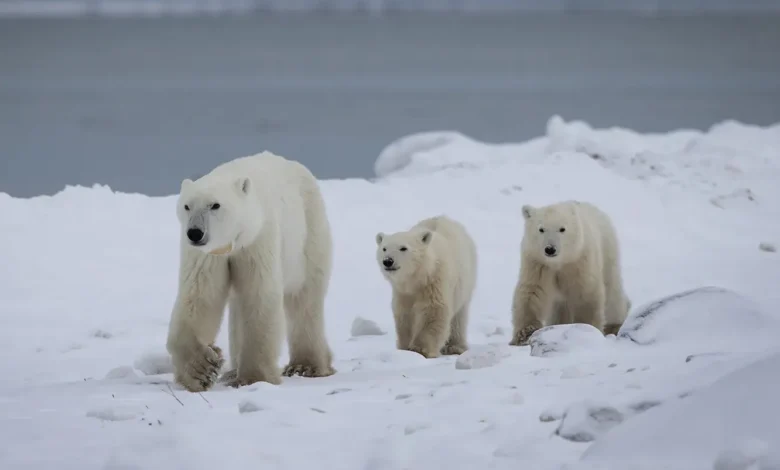
In one of the photos taken during the expedition, a young female—about five years old—can be seen walking through the snow with two cubs. Researchers had already tagged one of the cubs in the spring, when the mother first brought her litter out of the den. The second cub has no markings, which immediately caught the researchers’ attention. It stays close to the female, as if it were her own, never straying from her side.
Researchers suggest that polar bears may possess a strong maternal instinct that drives a female to care for a defenseless cub, even if it is not her own. Alysa McCall of Polar Bears International points out that the reasons for this behavior are not fully understood, but one thing is clear—such cases are extremely rare and always surprise experts.
Significance for the population
Both cubs, according to scientists, are in good condition and appear healthy. They are about 10–11 months old and will likely stay with their adoptive mother until they are two and a half years old. During this time, the cubs learn to hunt, find food, and survive in the harsh Arctic conditions. The presence of an adult female greatly increases their chances of survival, as in the wild only half the cubs reach adulthood.
Richardson emphasizes that in the face of rapid climate change and shrinking ice cover, such displays of care could play an important role in preserving the polar bear population around Churchill. If a female can feed and raise not only her own but also other cubs, this is good news for the entire species.
Unanswered questions
It remains a mystery what happened to the biological mother of the adopted cub. She may have died or lost her baby for some other reason. Scientists are currently conducting DNA analysis to determine the cub’s origins and try to uncover its fate. Such research helps us better understand polar bear behavior and their ability to adapt to changing environmental conditions.
Experts note that each of these cases offers a unique opportunity to study the social bonds and instincts of these animals. Paying attention to such stories is important not only for science but also for raising awareness about the challenges facing Arctic ecosystems.
In case you didn’t know, Environment and Climate Change Canada monitors wildlife and researches the impact of climate change on Arctic species. Polar Bears International is an international nonprofit organization focused on studying and protecting polar bears. Churchill in Manitoba is considered one of the world’s polar bear capitals, attracting scientists and tourists from around the globe each year to observe these remarkable animals in their natural habitat.