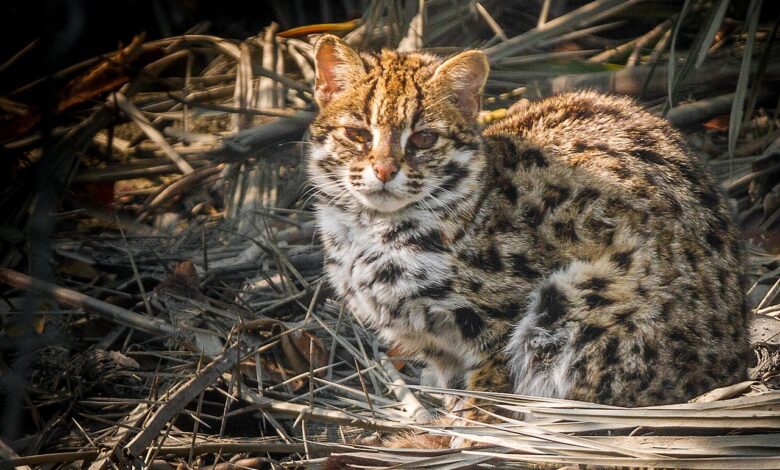
The history of cat domestication in China has turned out to be much more complicated than scientists previously thought. Archaeological finds and genetic studies have revealed some surprising details: long before the appearance of familiar domestic cats, wild Bengal cats (Prionailurus bengalensis) lived alongside humans. These predators accompanied people for more than three thousand years, but never fully became true domestic animals.
The earliest evidence of cohabitation between humans and cats in China dates back to the end of the 4th millennium BC. However, DNA analysis of ancient remains revealed that these were not Felis catus, but wild Bengal cats. These animals, found in forests and on the outskirts of villages, gradually adapted to living near people, feeding on grain stores and hunting rodents.
Ancient neighbors
Scientists performed radiocarbon dating and sequenced the genomes of 22 bone samples collected from fourteen archaeological sites across China. The age of the finds ranges from 3500 BC to 1800 AD. The results showed that over thousands of years, Bengal cats not only lived alongside humans, but also played an important role in protecting crops from pests.
A unique relationship developed between people and these wild cats. Bengal cats hunted mice and rats, while humans tolerated their presence, sometimes even feeding them or taking kittens to raise near their homes. However, these animals could never be fully tamed: they remained independent and retained their wild nature.
A partnership without domestication
This coexistence resembled an unspoken agreement: the cats had access to food and shelter, while humans received protection from rodents. Despite prolonged contact, Bengal cats never became household pets. They kept their hunting instincts and did not develop affection for humans, unlike today’s domestic cats.
Everything changed in the 3rd to 6th centuries AD. China was going through hard times: wars, climate disasters, and the decline of agriculture led to population decreases. As the fields and grain storage facilities disappeared, so did the favorable conditions for Bengal cats to live near people. Archaeological evidence shows that for several centuries, cats nearly vanished from human settlements.
The emergence of domestic cats
It was only in the 7th and 8th centuries that the situation changed. Domestic cats were brought to China via trade routes from western regions. These animals were different from the Bengals: they were calmer, friendlier, and posed no threat to poultry. The first domestic cats were considered a rarity and were kept mostly in noble households and at court.
Images of cats have been preserved on the murals of tombs from the 9th century, as well as written records describing how empresses would gift cats to members of the court. White cats were especially prized and thought to hold special significance. Gradually, domestic cats displaced the Bengal cats from human society, taking their place in homes and households.
Changing status
Unlike their wild ancestors, domestic cats quickly won the affection of people. They did not attack chickens or other birds, instead specializing in catching rodents. Thanks to these traits, they were readily welcomed into homes, and over time they completely replaced Bengal cats in human environments.
Today, Bengal cats are still considered pests in China. They are often blamed for attacks on domestic poultry, which has earned them the nickname ‘chicken tigers’ among locals. The relationship between humans and this species has completely deteriorated, leaving the Bengal cat wild.
The long road to domestication
The history of cats in China clearly shows that domestication is not a single event, but a complex and lengthy process. It depends on a wide range of factors: climate, economy, culture, and the way of life of society. In China, local wild cats failed to become domesticated—only imported domestic cats managed to become true companions.
The journey of the cat from wild hunter to beloved companion took thousands of years. Only when society was ready to accept the animal not just as a neighbor, but as a family member, did the cat find its place by the hearth.
In case you didn’t know, the Bengal cat (Prionailurus bengalensis) is a wild species found in the forests and plains of Asia. Unlike the popular “Bengal cat” breed developed in the 20th century, this species has never been fully domesticated by humans. Today, Bengal cats are protected in several countries, but in China, they are still considered pests. RUSSPAIN.COM reports that interest in the history of cat domestication remains strong, with new studies continuing to reveal surprising chapters from the past.