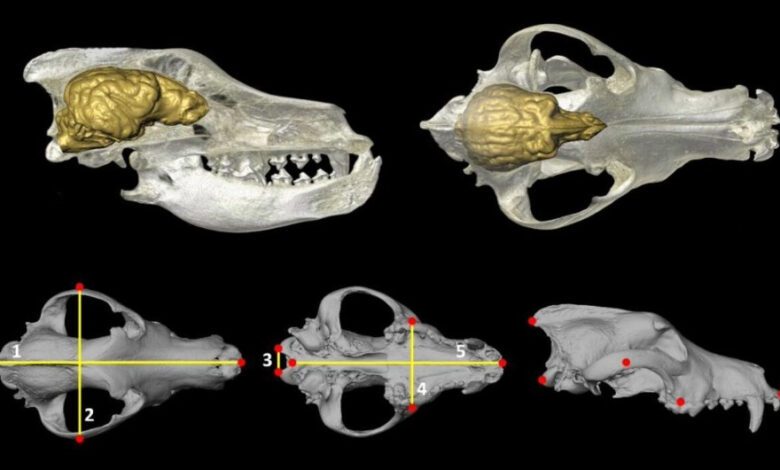
Five thousand years ago, dogs lived in what is now France whose brain size could rival that of today’s toy breeds. A new study by paleozoologists, analyzing the skulls of ancient and modern wolves and dogs, has revealed unexpected details: Neolithic dogs had brains almost twice as small as their wild counterparts. In some cases, their brain volume was close to that of Toy Terriers or even Chihuahuas.
Scientists from France, Australia, Belgium, Hungary, Germany, Italy, and Sweden conducted a large-scale analysis of endocasts—the internal cavities of the skull where the brain is housed. Their sample included modern wolves and various dog breeds, as well as animal remains unearthed at archaeological sites across Europe. Particular attention was given to skulls discovered at the Neolithic settlement of Chalain in eastern France.
The results were unexpected: the dogs from Chalain had brains 47% smaller than those of wolves living at the same time. Seven out of eight studied specimens matched the brain size of pugs, spitzes, and cocker spaniels, while one dog was reminiscent of a chihuahua or a pekinese.
Domestication and the brain
Brain shrinkage in domestic animals is not a new phenomenon. Scientists have long observed that domesticated species typically have smaller brains than their wild ancestors. This is linked to the fact that, living alongside humans, animals no longer need to solve complex problems, search for food, or defend themselves from predators. Maintaining a large brain requires a lot of energy, and in captivity, this luxury becomes unnecessary.
Dogs are one of the most striking examples. Compared to wolves, their brain volume has decreased by about a quarter. Researchers believe this process happened in two stages: first, soon after domestication, there was a sharp drop in brain size, then specific brain regions in dogs began to develop, responsible for carrying out the tasks set by humans.
In this new study, specialists reconstructed endocasts not only for modern breeds, but also for ancient animals, including the so-called “proto-dogs” from Goyet (Belgium) and the Baume-Trocard cave (France). These remains date back 35,000 and 16,000 years, respectively.
Archaeological finds
Researchers were particularly interested in the dog and wolf skulls discovered at the settlement of Chalen, which existed about 5,000–4,500 years ago. This was a stilt house settlement where archaeologists unearthed well-preserved animal remains. The analysis showed that wolf skull length decreased over time: from 263 mm in Pleistocene specimens to 239 mm in modern French wolves. In “proto-dogs,” this figure was even smaller—around 229 mm.
The dogs from Shalena were distinguished not only by their short skulls, but also by their tiny brains. They stood about 35 cm at the withers, and their skull structure was similar to that of modern herding dogs. However, in terms of brain size, they were closer to toy breeds than to working or hunting dogs.
For comparison: the brain volume of modern working breeds reaches up to 111 cubic centimeters, while toy breeds have about 60. In dingoes, this figure is 93, and in mixed-breed dogs, 80. Neolithic dogs from Shalena occupy an intermediate position between these groups.
Behavior and social role
The small brain size in Shalena dogs could indicate that their behavior resembled that of today’s small breeds. Such animals are often timid, prone to aggression toward strangers, bark frequently, and can be difficult to train. This raises questions about their practical usefulness for ancient people.
It is possible that these dogs served other purposes—for example, as companions or for ritual use. Interestingly, even in the Neolithic period, people were selectively breeding not only large but also miniature dogs. At the same time, selection was occurring at the opposite end of the spectrum: giant dogs appeared, capable of protecting herds from wolves.
Paleozoologists note that the domestication of wolves began as early as the Upper Paleolithic. The oldest dog remains have been found in Spain (Erralla cave), Germany (Bonn-Oberkassel), and France (Bom-Trocad), dating back 15–17 thousand years.
Evolution of size
Research shows that, over time, wolves and dogs have undergone significant changes in skull and brain size. While Pleistocene wolves had brains measuring up to 154 cubic centimeters, modern wolves average just 134. For dogs, this figure is even lower, especially among toy breeds.
The dogs from Shalain turned out to be a kind of bridge between ancient and modern breeds. Their skulls were similar in length to those of today’s mixed-breed dogs, while their brain volume resembled that of the smallest members of the canine family.
These discoveries offer a new perspective on the domestication and selective breeding of dogs in Europe. It turns out that as far back as five thousand years ago, people deliberately chose animals with traits that are now familiar to us.
In case you didn’t know, Thomas Cucchi is a leading expert at the National Museum of Natural History in Paris, who has devoted his career to studying the evolution of domestic animals. His team brings together researchers from across Europe and Australia, specializing in archaeozoology and paleogenetics. Thanks to their collaborative work, previously little-known aspects of ancient dogs’ lives and their role in Neolithic societies have come to light.