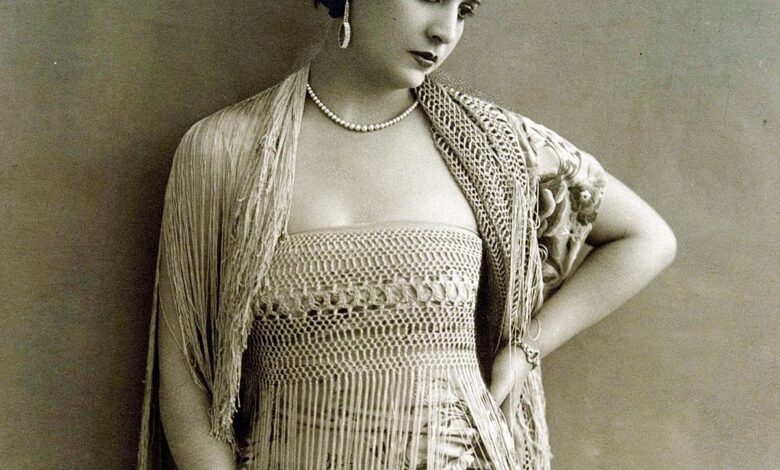
Madrid in the 1920s was a city of contrasts, where the glitter of the aristocracy mingled with the vibrant life of the bohemian scene. In this world, King Alfonso XIII was known not just as a monarch but also as an indefatigable admirer of female beauty, whose exploits were an open secret. It was during this period that a new star emerged on the capital’s stage—young Celia Gámez, a revue performer from Buenos Aires, whose exotic charm and bold talent captivated Spanish audiences.
A fateful meeting happened almost by chance. Celia arrived in Spain from Argentina with her father to settle inheritance matters. During a train ride from Barcelona to Madrid, she enchanted her fellow passengers with her singing, among them the Marquise de la Corona. Impressed by the young woman’s talent, the aristocrat invited her to perform at a charity evening in the newly opened Pavón Theater.
That night, the presidential box was filled with the upper echelons of power: Alfonso XIII himself with his wife Victoria Eugenia, the Queen Mother María Cristina, and General Primo de Rivera. The king was smitten. Soon after the performance, the Marquess de Viana came to the twenty-year-old Celia with an invitation from the monarch to a private tea. Thus began their romance, which, though it lasted only a few months, caused a considerable stir.
For his secret rendezvous, Alfonso XIII used pseudonyms—Duke of Toledo or Monsieur Lamy—though his incognito rarely fooled anyone. Meanwhile, Celia’s career soared. Her debut at the famed Romea theater on January 14, 1926 earned her the nickname “The Pearl of La Plata.” She didn’t have a perfect singing voice, but her stunning legs and radiant smile made up for any shortcomings.
The king became a regular at the Romea, rarely missing a performance by his favorite. It’s said he was crazy about the tango “A media luz” (“In Semidarkness”), which Celia performed dozens of times just for him, both onstage and in private. When she moved to another theater, Eslava, her devoted admirer followed. But as with many of his other lovers, this affair brought Celia little happiness—the monarch quickly lost interest and left her.
Queen Victoria Eugenie apparently remained unaware of her husband’s new infatuation for quite some time. The culmination of this awkward situation came when she visited Celia Gámez backstage. Notably, the queen didn’t come alone—she was accompanied by her elder sons, the Prince of Asturias and Infante Jaime. The meeting between the two women was surprisingly cordial, but all of Madrid buzzed with gossip and biting jokes. Many see this as the height of the queen’s humiliation, though given Alfonso XIII’s many illegitimate children and affairs, it’s hard to single out the most embarrassing episode.
Despite their separation, Celia and Alfonso maintained a friendly relationship. She sought his help in obtaining Spanish citizenship and remained a staunch monarchist until the end of her days. Her life remained eventful: in 1944, she married a dentist, with General Millán Astray serving as best man at the wedding. This marriage ended nine years later. Her second marriage, to a journalist, was also short-lived. In the 1960s, her passion for gambling led to financial difficulties. In the early 1970s, she appeared in several films before returning to Buenos Aires. Her last appearance on the Spanish stage was in 1984. She spent her final years back home, suffering from Alzheimer’s disease, where she was eventually laid to rest.
Incidentally, Alfonso XIII, who ruled Spain from 1902 to 1931, was the country’s last monarch before the establishment of the Second Republic. His reign was marked by political instability and ended with his exile. Despite marrying the British princess Victoria Eugenie of Battenberg, granddaughter of Queen Victoria, their family life was overshadowed both by hemophilia passed on to their sons and the king’s numerous affairs. Alfonso XIII acknowledged fathering several illegitimate children, while rumors linked him to dozens more romances. He died in exile in Rome in 1941.