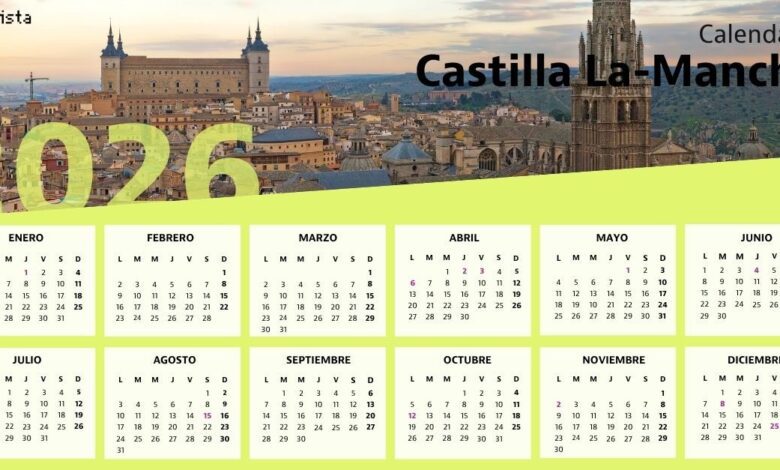
The government of Castilla-La Mancha has officially approved the work calendar for 2026. Residents of the region will have twelve public holidays set at the regional level. In addition, each municipality will add two of its own holidays that reflect local traditions and customs.
National holidays with a local touch
The year will start with the traditional holidays: January 1 (New Year’s Day) and January 6 (Epiphany) offer opportunities for family gatherings. In some towns, like Alcázar de San Juan, Epiphany is celebrated on a grand scale as they consider themselves the ‘cradle of the Wise Men.’ Spring festivities will be centered around Easter. Good Friday, April 3, will be a holiday across the country. In Castilla-La Mancha, this season is marked by unique processions: in Cuenca, the Las Turbas parade takes place, while the night streets of Toledo are lit up by candles.
May 1st, Labor Day, is a popular time for outings to scenic spots like the Montes de Toledo or the source of the Mundo River. The summer holiday peak falls on August 15, the Feast of the Assumption of the Virgin Mary. This date coincides with patron saint festivals in hundreds of towns, turning the region into a hub of music, fairs, and folk celebrations. In autumn, the holidays will be October 12 (Spanish National Day), which here is closely linked to local folklore, and December 8 (Immaculate Conception), when monumental Nativity scenes open across the region. The year ends with Christmas, December 25, when the famous Toledo marzipan—made according to ancient recipes in local monasteries—appears on the tables.
Special Regional Holidays
In addition to nationwide public holidays, the region’s calendar features its own unique dates. Maundy Thursday, April 2, will also be a day off, giving locals a chance to immerse themselves in the atmosphere of Holy Week. An interesting decision was made regarding Saint Joseph’s Day (San José): the holiday from March 19 has been moved to Monday, April 6, thus extending the Easter break.
Castilla-La Mancha Day will be celebrated on Sunday, May 31, with craft fairs and tastings of local specialties, from Manchego cheese to La Mancha wines. Another date change concerns Constitution Day: as December 6, 2026 falls on a Sunday, the holiday will be observed as a day off on Thursday, June 4—the day of Corpus Christi. The festival is especially vibrant in Toledo, where the streets are decorated with floral carpets. All Saints’ Day (November 1) also falls on a Sunday, so Monday, November 2, is declared a non-working day. This period is marked not only by visits to cemeteries but also by the preparation of traditional sweets.
Local fiestas in provincial capitals
Each provincial capital will add two of its own holidays to the general calendar. In Albacete, June 24 (San Juan) and September 8 (Virgen de los Llanos) will be non-working days. Ciudad Real will celebrate May 25 (Virgen de Alarcos) and August 22 (Octave of Virgen del Prado). Residents of Cuenca will honor their patroness, Virgen de la Luz, on June 1, and celebrate San Mateo on September 21, marking the end of the city fair.
In Guadalajara, the non-working days will be September 8 (Virgen de la Antigua) and September 18, dedicated to the city’s main festivities. Toledo will celebrate its patron, San Ildefonso, on January 23. And for the first time, November 26 will be an official holiday marking the 40th anniversary of Toledo’s UNESCO World Heritage status. This event will feature major cultural activities and exhibitions.