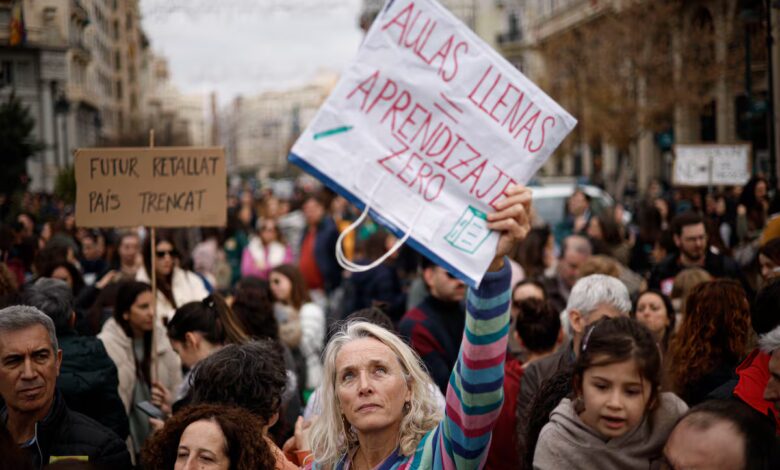
On Thursday, the Valencian Community saw the second large-scale teachers’ strike of the current term. Educators, backed by major unions, took to the streets to demand urgent changes: higher salaries, smaller class sizes, improved infrastructure, and protection for teaching in the Valencian language. Many participants said the education system has reached a critical point.
Teachers report that their salaries have not been indexed for years, and class sizes often exceed 30 students. This results in overwhelming workloads and makes it impossible to give each child the attention they need. Additionally, teachers complain about delays in replacing sick colleagues, which leads to lost instructional hours for students. The issue is particularly acute in areas recently affected by natural disasters, where schools have yet to be restored.
Disagreement over the numbers
According to official figures from the regional Ministry of Education, about 17% of teachers participated in the strike. In the province of Valencia, the rate was a little over 18%, in Alicante—almost 18%, and in Castellón—around 14%. However, unions insist that at least 60% of educators joined the protest, and final figures will not be known until the evening shift is counted.
According to authorities, more than 12,000 teachers out of nearly 71,000 stopped working in total. Union representatives emphasize that the scale of the protest reflects deep discontent within the education sector. They are demanding that the new leadership of the Ministry of Education begin negotiations and not ignore the workers’ demands.
Demands and Concerns
Unions insist on restoring teachers’ purchasing power, which has been lost over the years, paying full bonuses, and enshrining in law an annual wage indexation mechanism in line with inflation. In addition, they are calling for a multi-year agreement to bring pay levels in line with the national average.
Among other demands are reducing class sizes, restoring previously cut staff—especially in vocational education, language schools, and conservatories—as well as promptly filling all vacancies and replacing absent staff. Special attention is given to protecting the Valencian language in schools: educators fear that new government initiatives could drive it out of the curriculum.
The Language Issue
In recent years, the issue of teaching in Valencian has become one of the most contentious in the region. Unions and teachers believe the government’s new policy is aimed at reducing the use of the regional language in schools. Last year, authorities conducted a survey among parents, asking them to choose the main language of instruction for their children. The results were nearly evenly split: just over half of families chose Valencian, while the others opted for Spanish.
Educators and unions are convinced that such measures undermine the status of the Valencian language and are calling for legislative guarantees to ensure its preservation and development in educational institutions. They emphasize that language is an integral part of the region’s cultural identity.
Geography of protests
The strike and rallies were held not only in the capitals of the three provinces, but also in dozens of cities and municipalities: Elche, Dénia, Alcoy, Elda, Torrevieja, Orihuela, Sagunto, Alzira, Gandia, Xàtiva, Ontinyent, and La Vall d’Uixó. In each of these localities, teachers and parents took to the streets to support calls for change in the education system.
In Alicante, one of the largest demonstrations took place in the morning. Union representatives pointed out that teachers’ real incomes have dropped by more than a quarter since 2010. Many participants noted that educators’ patience is running out, and unless the authorities open a dialogue, protests will continue.
Infrastructure problems
A platform advocating for quality public education, uniting parent associations and labor unions, organized evening demonstrations in the three provincial capitals. In their statement, participants emphasized that many schools have yet to be restored after devastating weather events, and there is a lack of funds for repairs and modernization. According to their estimates, the region needs more than 120 million euros restored to the infrastructure budget that was previously cut.
The platform is also demanding immediate action to improve teachers’ working conditions and to provide all schools with the necessary resources. If the authorities fail to respond, unions have promised further protests and strikes in the near future.