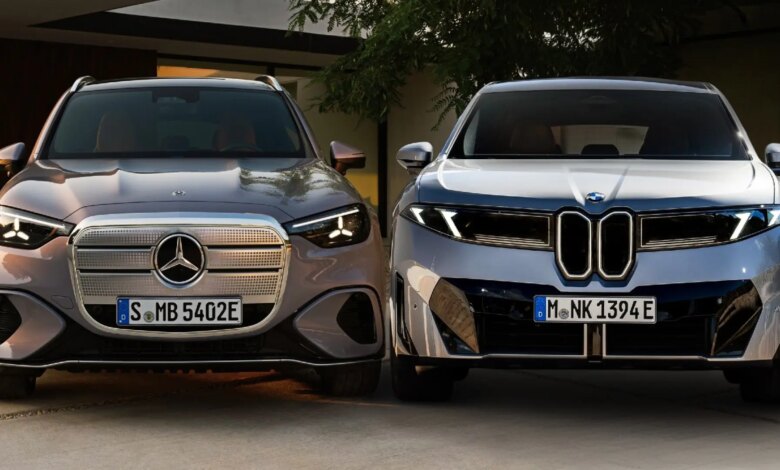
The shift to electric vehicles in the premium segment is no longer just a trend, but a reality that is redefining comfort and capabilities. Buyers choosing between the BMW iX3 and the Mercedes GLC face a dilemma: is maximum driving range or spaciousness and technology more important? Both vehicles represent a new generation of German SUVs, yet the differences between them are crucial for those seeking not only status but also practicality.
The BMW iX3 stands out among its competitors with an impressive range of 805 kilometers on a single charge—one of the best figures in its class of electric vehicles. The Mercedes GLC, despite a higher price, offers less autonomy but makes up for it with a more spacious interior and well-thought-out ergonomics. For family trips and long journeys, this can become a decisive factor.
Technology and comfort
Inside, the Mercedes GLC welcomes the driver and passengers with a massive display panel uniting three screens at once. The optional MBUX Hyperscreen system transforms the cabin into a true digital cockpit, where controls are managed by artificial intelligence and voice commands. Even the standard configuration is equipped with modern multimedia solutions and a virtual assistant capable of understanding natural speech.
The BMW iX3 keeps up in terms of equipment. The panoramic iDrive system with three screens, including the innovative Panoramic Vision, places not only speed and navigation but a host of vehicle parameters at your fingertips. The new BMW Operating System 10 ensures fast operation of all functions and intuitive control. In the rear, there is ample space for two adult passengers, and the trunk holds 520 liters, which is slightly less than the Mercedes.
Both crossovers are equipped with advanced safety systems: cameras, radars, and ultrasonic sensors monitor the road, while assistants help with emergency braking, lane changes, and parking. The Mercedes GLC puts special emphasis on adaptive cruise control and collision prevention, while the BMW iX3 stands out for its fast charging capabilities and V2L function for powering external devices.
Performance and charging
The Mercedes GLC is equipped with two electric motors with a combined output of 489 horsepower, providing confident acceleration and all-wheel drive. The 94 kWh battery allows for a range of up to 666 kilometers, and the optional Long Range version pushes this figure to 707 kilometers. Charging is fast: from 10 to 80% capacity can be replenished in 22 minutes at 330 kW. For urban environments, charging from a regular outlet is supported with power up to 22 kW.
The BMW iX3 features two motors—an asynchronous motor at the front and a synchronous motor at the rear—with a combined output of 469 hp and 645 Nm of torque. Its main highlight is a 108.7 kWh battery integrated into the body structure. Thanks to this, the range reaches up to 805 kilometers, and the maximum charging power is 400 kW. In just 10 minutes, you can gain an extra 372 kilometers of range, making it especially valuable for those who frequently travel long distances.
The ability to supply energy to external devices (V2L) and even power home electrical grids (V2H) makes the BMW iX3 a versatile assistant both on the road and at home. This approach is already used by some Chinese models, as recently discussed in a feature on affordable electric crossovers with extended capabilities.
Price and practicality
The BMW iX3 starts at €69,900, noticeably lower than the Mercedes GLC, which is priced from at least €77,125. Even if you opt for the Mercedes version with extended range, the price difference remains. At the same time, BMW offers not only greater autonomy but also faster charging—a key factor for active drivers.
The Mercedes GLC wins in trunk volume—570 liters plus 128 liters at the front, which is convenient for transporting large luggage or sports equipment. The BMW iX3 front trunk is smaller at 58 liters, but the main compartment is spacious enough for everyday needs. Both vehicles are built for long-term use and equipped with advanced battery health monitoring systems.
The Mercedes offers slightly better dynamics thanks to its higher power output, but in real-world conditions, the difference is only noticeable during sharp accelerations. The BMW iX3 stands out for its more precise handling and balanced suspension, making it an appealing choice for those who value both driving excitement and comfort.
In terms of technology and safety, both crossovers are on par, offering a wide range of options for personalization and convenience. Buyers focused on long-distance travel and reduced charging times are likely to prefer the BMW iX3, while those who appreciate spaciousness and a premium interior will be drawn to the Mercedes GLC.
The BMW iX3 is a new-generation electric crossover that combines a record driving range, high power, and cutting-edge technology. This model is designed for drivers who value not just status and comfort, but also practicality in daily life. Thanks to innovative solutions in charging and energy efficiency, the iX3 stands out as one of the most attractive options in the premium EV market. The Mercedes GLC, meanwhile, emphasizes spaciousness, advanced technology, and a distinctive style, which continues to appeal to fans of the brand.