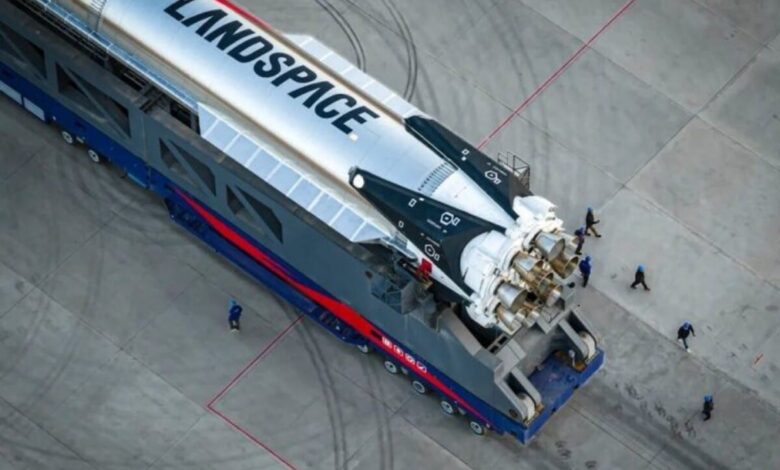
The Chinese private company LandSpace conducted a test launch of its latest rocket, Zhuque-3, but the attempt to recover the first stage ended in failure. Although the payload was successfully delivered into orbit, the final phase of the mission failed: the stage crashed when its engines fired to slow down just before landing. Video from the site quickly spread across social media, sparking intense discussion among industry experts and space enthusiasts.
LandSpace was founded in 2015 when reforms in China opened the door for private companies to participate in space projects. Within a few years, the startup attracted over $400 million in investment, including funds linked to the government. This investment enabled the development of proprietary liquid-fueled engines and the lightweight Zhuque-2 rocket, which, in 2023, became the first methane-fueled rocket in the world to reach orbit. Since then, Zhuque-2 has launched six times, with four missions considered successful.
The race for reusability
LandSpace’s main goal is to develop a more powerful and partially reusable rocket to meet the growing demand for satellite services in China. The company now competes not only with state giants but also with other private startups that are also vying for a share of the launch market. Chinese authorities are actively supporting the industry’s growth, as the country needs to catch up with the United States, where SpaceX and other companies have long been using reusable technologies.
In recent years, several major satellite constellations have been deployed in China, each requiring thousands of satellites to provide data and internet services worldwide. Without mass satellite production and rocket reusability, China will find it difficult to compete with American companies such as SpaceX and Blue Origin. This is why progress in creating reusable launch vehicles is becoming strategically important for the country.
Technical features
The first version of the Zhuque-3 is designed to deliver up to eight tons of payload to low Earth orbit, including the fuel needed to return the first stage. The rocket stands nearly 66 meters tall. In the future, LandSpace plans to upgrade the launcher, boosting its reusable payload capacity to 18.3 tons, and even more in the expendable version.
Externally, the new LandSpace rocket resembles SpaceX’s Falcon 9: it has nine engines on the first stage, four folding landing legs, and grid fins for descent control. Chinese engineers openly admit being inspired by American developments, but emphasize that all key technologies have been developed domestically.
Competition and Prospects
A fierce battle for leadership is unfolding in China’s domestic launch market. Companies that are the first to master reusable rocket technology will gain a significant edge and be able to compete for major government and commercial contracts. LandSpace is betting on ‘Zhuque-3’ as its main project in this race.
The failed landing of the first stage did not come as a surprise to experts; similar setbacks accompanied SpaceX’s earliest attempts. Nonetheless, the very fact that the payload was successfully delivered and the stage returned to the landing site—albeit with an accident—demonstrates the advanced level of China’s private space technology. In the coming years, LandSpace plans to conduct several more test launches to bring the system to full operational capacity.
The Future of Chinese Launches
Dozens of startups in China are already developing their own rockets and satellites. The government is actively investing in the sector, fostering conditions for new players and the adoption of cutting-edge technologies. The number of launches and new models of reusable vehicles is expected to increase in the coming years.
LandSpace aims not only to strengthen its position in the domestic market but also to enter the international stage. The company hopes that the upgraded version of Zhuque-3 will be able to compete with the world’s best models and attract foreign clients. To achieve this, engineers are continuing to improve the engines, control systems, and landing technologies.
If you didn’t know, LandSpace is one of China’s first private space companies, founded in Beijing in 2015. It specializes in developing liquid-fueled launch vehicles and is actively implementing reusable booster technology. In 2023, LandSpace became the world’s first company to successfully launch a methane-powered rocket into orbit. The firm now competes with leading Chinese and international rocket manufacturers, aiming for a top position in the commercial launch market.