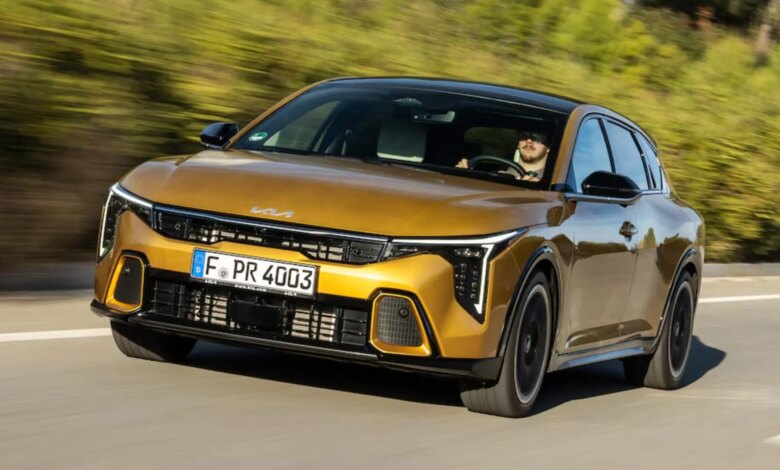
The arrival of the Kia K4 on the European market came as a surprise to car enthusiasts accustomed to the dominance of electric vehicles and crossovers. At a time when automakers are rapidly shifting to electric power, the Korean brand is banking on gasoline engines and a classic silhouette. This choice could sway buyers who are tired of the SUV monotony and are seeking something fresh among compact cars.
Instead of the familiar high seating position and bulky shape, the K4 offers a low stance and sporty profile. With a body height of just 1.43 meters, it stands out among competitors. The model is produced in Mexico, at the factory in Pesquería, and the car measures 4.44 meters in length. The K4’s exterior evokes a wagon with sporty design elements—broad shoulders, a sloping roofline that visually creates a ‘floating’ roof effect. This styling approach clearly targets those who value individuality and aren’t afraid to stand out on the road.
Interior and technology
Inside, the K4 strikes a balance between modern technology and practicality. The centerpiece is the Connected Car Navigation Cockpit—two 12.3-inch screens combined into a single digital area. Despite its futuristic look, engineers have retained physical buttons for key functions, something drivers who prefer tactile controls will particularly appreciate. Among the features is a separate programmable key for quick access to favorite settings.
The only debatable element of the interior is the massive automatic gear selector, which seems excessive against the minimalist design. However, the cabin space is pleasantly surprising: thanks to a 2.72-meter wheelbase, passengers enjoy comfort even on long journeys. The trunk capacity ranges from 438 to 1,217 liters, making the K4 one of the roomiest in its class.
In terms of digital features, the car holds its own against modern competitors. Software updates are delivered over the air (Over-the-Air), and a smartphone can be used as a key. This set of options meets the expectations of demanding European buyers, for whom convenience and technology are key factors in choosing a car.
Engine and Performance
The K4’s engine range consists entirely of petrol units. The base version is equipped with a three-cylinder 1.0-liter engine producing 115 hp, suitable for relaxed city driving. However, the top-end modification generates the most interest, offering a 1.6-liter turbocharged engine with 180 hp and 265 Nm of torque. This engine accelerates to 100 km/h in 8.4 seconds, with a top speed of 210 km/h.
The curb weight of the car starts at 1.5 tons, which is slightly higher than its closest competitors. For example, the Volkswagen Golf 2.0 TSI with similar power is 60–100 kg lighter, and the Golf version with 150 hp is almost 140 kg lighter. This affects fuel consumption and maneuverability, especially during active driving. However, with measured driving, the extra weight is almost unnoticeable, while sound insulation and ride comfort remain at a high level.
Market context
Kia’s decision to forgo electrification for the K4 stands out as bold against European trends. While Chinese manufacturers such as Geely are actively promoting affordable electric cars and even setting sales records—as was the case with the Geely EX2, which, according to Chinese automobile market analysts, has become a real hit—Kia is betting on traditional values. This approach may appeal to those not ready to switch to electric vehicles because of infrastructure limitations or personal preference.
In a context where European cities are tightening environmental standards and the cost of owning an electric car remains high, the introduction of the gasoline-powered K4 is seen as a challenge to established norms. This is not just an alternative, but an attempt to revive interest in classic compacts that once symbolized practicality and affordability.
Practicality and target audience
Potential K4 buyers are not only brand enthusiasts, but also those looking for a versatile car for city driving and travel. Its spacious interior, large trunk, and modern electronics make the model attractive to families and young professionals. The lack of hybrid and electric versions may deter part of the audience, but for many, the easy maintenance and reliability of the gasoline engine remain decisive factors.
In Spain, where practical and economical cars are traditionally valued, the K4 is set to carve out its own niche. This is especially true amid rising electric vehicle prices and a limited selection of compact models with conventional drivetrains. In the coming years, demand for such cars may even grow if manufacturers continue reducing their gasoline lineups.
Kia is a South Korean automaker that has grown from a regional player into one of the leaders of the global market over the past decades. The company is known for its innovative approach to design and technology, as well as its diverse model range—from city compacts to crossovers and electric vehicles. In Europe, the brand has gained popularity thanks to its combination of affordable prices, high quality, and extended warranty. The K4 model is further evidence of Kia’s commitment to forging its own path, offering buyers an alternative to mass-market trends while staying true to classic values.