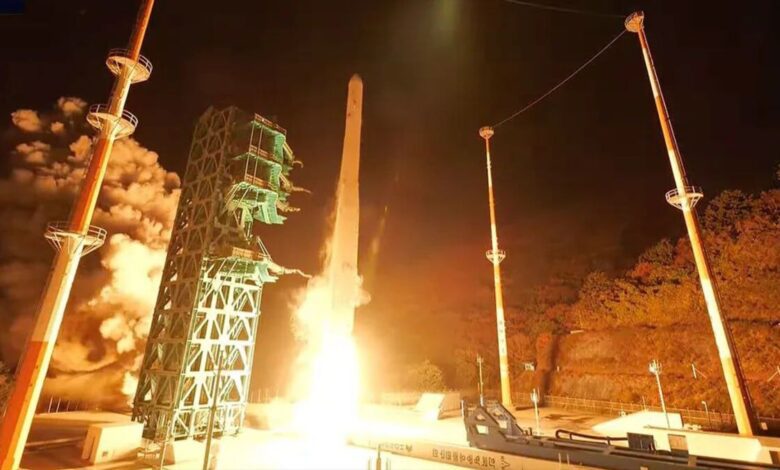
The South Korean Nuri launch vehicle successfully lifted off from the Naro Space Center on November 26, setting a new national record for the number of satellites sent into space in a single launch. Onboard were the Earth observation satellite CAS500-3 and twelve small CubeSats developed by the country’s universities, research centers, and private companies. This launch marked a significant milestone for South Korea’s space industry, demonstrating its growing technological capabilities and independence in space exploration.
The mission’s primary payload, CAS500-3, is designed for monitoring atmospheric processes and observing the Earth’s surface. Once it reaches its sun-synchronous orbit at approximately 600 kilometers altitude, the satellite will begin collecting data for scientific research and practical applications related to ecology and agriculture. The remaining twelve CubeSats will carry out their own experimental and technological projects, broadening the range of objectives achieved in a single launch.
Nuri is the first fully developed and assembled three-stage launch vehicle in South Korea, capable of delivering payloads into orbit. Unlike the previous Naro-1 rocket, which incorporated Russian components, the new system was created entirely by domestic engineers. This milestone enabled the country to make significant progress in developing its own space infrastructure and reducing reliance on foreign technology.
A Technological Breakthrough and New Opportunities
The launch on November 26 marked Nuri’s third successful flight following its unsuccessful debut in 2021, when the rocket failed to place its payload into orbit due to technical issues. However, back-to-back successful launches in 2022 and 2023 restored confidence in the project and allowed its scope to expand. For the first time in South Korean space history, the integrator company was responsible not only for manufacturing and assembling all the rocket’s components, but also for conducting the launch operation itself.
This experience proved vital for the national space program, as it enabled a full cycle of development and operation of a launch vehicle. As a result, South Korea moved closer to achieving the status of a nation capable of independently developing, producing, and launching complex spacecraft. Such a level of technological independence opens up new prospects for scientific research, commercial launches, and international cooperation.
The launch’s significance for science and business
Deploying thirteen satellites in a single launch is not only a technological milestone but also a significant step for both scientific and commercial projects. University and research CubeSats will carry out experiments in communications, environmental monitoring, and the testing of new technologies. This will provide South Korean scientists and engineers with valuable data and experience crucial for the further development of space systems.
For private companies, participation in such missions offers access to in-orbit testing of their own innovations, fostering growth and development in the space services market. In the long run, projects like these may lead to the emergence of new commercial offerings and strengthen South Korea’s position in the global space launch industry.
Prospects for the national space program
The successful Nuri launch, which set a record for the number of satellites deployed, demonstrates that South Korea is progressing steadily toward building an independent, homegrown space infrastructure. In the coming years, the country plans to advance rocket technologies, broaden the scope of both scientific and commercial missions, and strengthen cooperation with international partners.
The country’s authorities have already announced plans to increase investment in the space sector and support innovative projects related to near-Earth exploration. It is expected that new achievements in this field will help South Korea secure a more prominent place among the world’s leading space powers.
By the way, about the ‘Nuri’ rocket and South Korea’s space program
Incidentally, the Nuri (KSLV-II) launch vehicle has become a symbol of South Korea’s technological progress in space exploration. It was developed by the Korea Aerospace Research Institute (KARI), founded in 1989 and now the country’s leading research center for aerospace technologies. The Nuri project was launched in the 2010s with the goal of creating a fully domestic rocket capable of placing various types of satellites into orbit.
The first Nuri launch took place in October 2021, but the mission ended in failure due to the premature shutdown of the third-stage engine. Nevertheless, the team of engineers and scientists quickly addressed the issues identified, and by June 2022, the rocket successfully delivered its first satellite into orbit. Another successful launch followed in May 2023, enabling the team to gain valuable experience for future missions.
Today, KARI actively collaborates with universities, industry partners, and international organizations, advancing not only rocket technology but also satellite systems and projects focused on lunar and deep space exploration. Thanks to these efforts, South Korea is gradually becoming one of the key players in the global space industry.