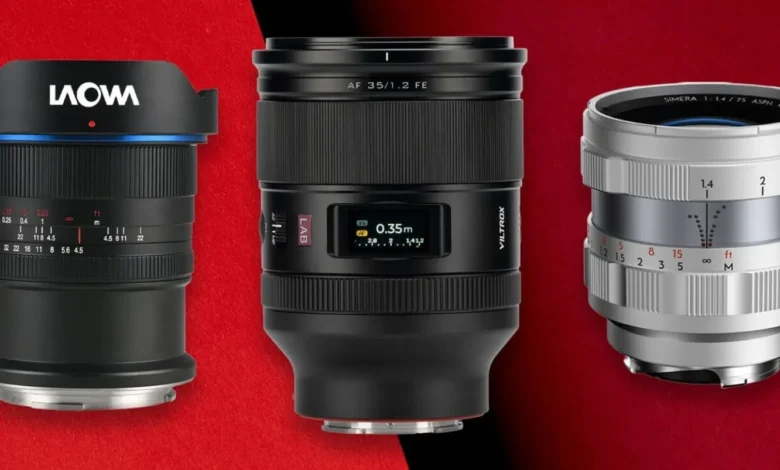
By 2025, Chinese lens manufacturers had shed their reputation as purely budget players. Their products now compete with global giants not just in price, but in quality, design, and technology. The market is seeing an influx of unique models, creating a standalone ecosystem rather than simply supplementing the lineups of established brands. Chinese companies have firmly secured positions across various niches—from ultra-wide macro lenses to professional portrait glass and vintage solutions for those who appreciate a distinctive visual style.
Consumers are now choosing optics from China not for affordability but for the combination of features, innovation, and tailored solutions for specific shooting needs. In 2025, it became evident: Chinese lenses are no longer a compromise but a legitimate choice for both professionals and enthusiasts.
Wide-Angle Solutions
In the wide-angle lens segment, Chinese brands displayed notable ingenuity in 2025. With less rivalry in conventional focal lengths, there’s more room for experimentation and unconventional engineering. Laowa once again surprised the market with its 15mm f/4.5 Macro—a compact lens boasting minimal distortion and true macro capability. This model has found demand not only among architectural photographers, but also those specializing in product and detail shots.
Laowa has continued to expand its lineup of tilt-shift and ultra-wide cine lenses, including Zero-D and anamorphic models. Not all innovations have been equally successful, but the company’s focus on innovation is clear. TTArtisan and 7Artisans have taken a more pragmatic approach: TTArtisan introduced affordable autofocus wide-angle lenses for APS-C, filling gaps in various systems, while 7Artisans focused on ultra-compact and budget-friendly models for street and travel photography. These lenses aren’t designed for universal use, but they clearly cater to the needs of their target audience.
Portrait and telephoto lenses
In 2025, Chinese manufacturers made a significant breakthrough in the portrait and telephoto lens segment. Viltrox emerged as the undisputed leader, launching the 135mm f/1.8 LAB—one of the year’s standout releases. This lens delivers excellent sharpness even at wide open apertures, fast autofocus, and optical quality on par with top Japanese counterparts. The LAB series has firmly established itself as a professional line rather than just an advanced option for enthusiasts.
Other models followed the same direction: the 85mm f/1.8 Pro and more affordable portrait lenses from Viltrox offer consistent results and reliable mechanics at prices that until recently seemed impossible for this class. Sirui and Meike also strengthened their positions in the hybrid segment, offering lenses that perform equally well for both photo and video. Their products are valued by small production teams and independent creators for their balance of quality and affordability.
Classics and vintage
In the classic focal lengths of 35mm, 50mm, and 75mm, Chinese brands in 2025 focused on delivering a unique image character. Thypoch emerged as a true revelation: the Simera 75mm f/1.4 nearly made it to the list of the year’s best lenses thanks to its expressive rendering, excellent optical discipline, and thoughtful design. A similar approach can be seen in other brand models, such as the Simera 28mm f/1.4 and Eureka 50mm f/2, which are aimed at mindful, deliberate shooting.
Light Lens Lab continued its revival of legendary optics from the past. The 50mm f/1.5 Z21, inspired by the rare Angenieux, and the announcement of the 35mm f/1.4 “11873” have shown that interest in optical heritage can be more than just collectible—it can also be practical. These lenses are chosen not for sheer speed, but for the unique visual experience and distinct identity they bring to each frame.
Ecosystem and trends
2025 marked a turning point for Chinese optics: it ceased to be seen as just a ‘budget alternative’ and became an independent force in the market. Today, lens choice is more often determined not by the country of manufacture, but by shooting needs, style, and the photographer’s or videographer’s personal preferences. If this trend continues, by 2026 Chinese brands are set to finally shed old stereotypes and secure a strong footing in the professional segment.
The launch of new models and the expanding range signal the emergence of a full-fledged ecosystem, offering solutions for everyone—from experimenting with optical effects to demanding professional work. Chinese manufacturers are no longer just catching up but are now setting trends, as evidenced by the market’s response and feedback from Western experts.