Expedition off the coast of Norway: an unexpected turn of events
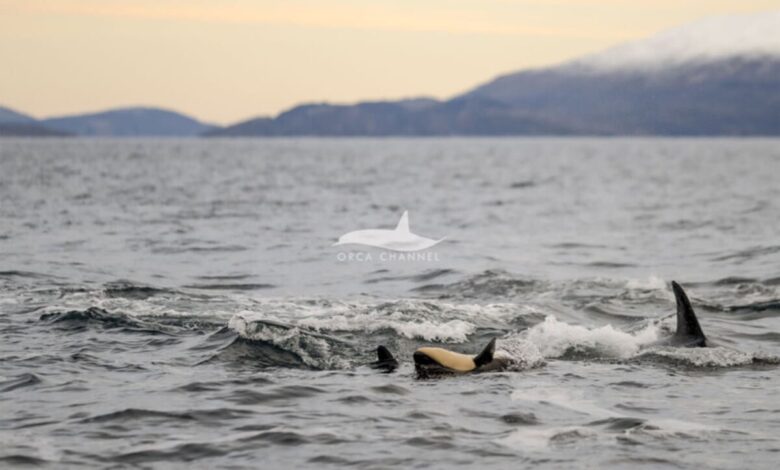
In early November 2025, a group of researchers and photographers set out on a sea voyage off the coast of Skjervøy to observe the lives of killer whales. Among the team was Kristina Balotoy, a wildlife photography specialist. That day, the team tracked a group of marine predators made up mostly of females and young animals. The animals were calmly feeding, showing no signs of alarm. But the usual scene suddenly gave way to something completely unexpected.
Suddenly, the water near the boat turned crimson and the surface foamed with splashes. For a moment, the expedition members could not understand what was happening. Within seconds it became clear: right before their eyes, a killer whale calf was being born. This event turned out to be a true sensation for everyone present, as such moments in the wild had never before been captured on film.
First moments of life: pod’s reaction and care for the newborn
As soon as the calf was born, the group’s behavior changed dramatically. The killer whales instantly formed a tight circle around the newborn, creating a kind of protective barrier. The adults supported the baby at the water’s surface, helping it take its first breath. This behavior reveals the high level of social organization among these marine mammals.
During the first hour after birth, the pod did not leave the calf’s side for a moment. The orcas showed remarkable activity, supporting and protecting the newborn. Scientists on board noted that such observations are extremely rare and can provide valuable insights into the structure and interactions within orca family groups.
Scientific value of unique images: new frontiers for research
The photos and videos already sparked great interest among marine mammal experts. According to specialists from the Norwegian Orca Research Center, these materials will form the basis for future scientific publications. Researchers plan to analyze the behavior of adult orcas in the first minutes after the calf’s birth to gain a better understanding of role distribution and support mechanisms within the pod.
The uniqueness of this situation lies not only in the rarity of the event itself, but also in the opportunity to observe it in natural conditions, without human interference. Such data will help deepen our understanding of socialization and survival among orcas, and will also expand knowledge about their biology.
The impact of this discovery on future marine mammal research
The emergence of such detailed photo and video documentation of an orca birth opens up new opportunities for science. Experts can now compare the behavior of different groups and analyze how pod dynamics change during critical moments. Additionally, the materials obtained will serve as a valuable resource for educational and outreach projects dedicated to marine life.
This case has already become a topic of discussion within the scientific community and will likely lead to new expeditions and research in Arctic waters. Thanks to the work of the photographer and researchers, humanity has gained a unique glimpse into the most intimate moments of orca life, which until now have remained a mystery.