Ancient Traces on the Rocks: The Mystery of Monte Conero
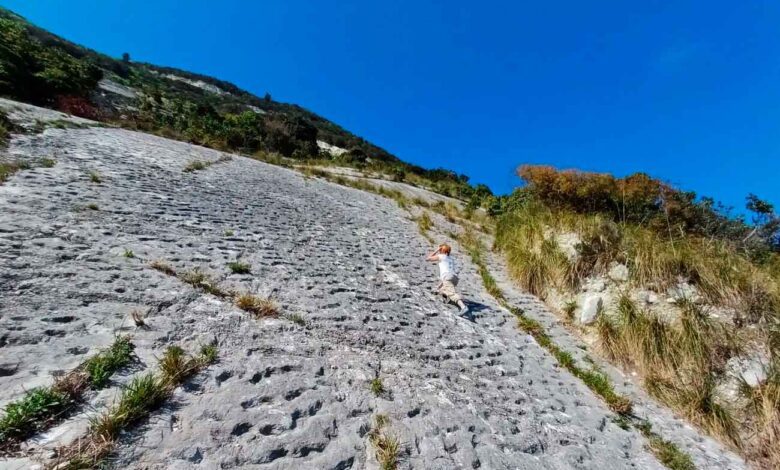
On the Adriatic coast, in the Monte Conero area, researchers have encountered an unusual phenomenon: on sheer cliffs and fallen limestone slabs, thousands of indentations resembling flipper prints have been discovered. These traces, estimated to be about 83 million years old, were found by chance—climbers, exploring hard-to-reach spots, noticed the strange shapes on the limestone surfaces. Photos of the discovery quickly captured the attention of the scientific community.
Geologists from the Coldigioco Center, led by Alessandro Montanari, obtained permission to conduct research in the protected area. Drones were used to study the highest and most dangerous sections. During the expedition, specialists documented over a thousand prints, grouped in two main locations: one more than 100 meters above the ground, and another on a massive slab that had collapsed onto La Vela beach.
Hypotheses and Scientific Debate: Who Left the Traces?
Scientists faced a pressing question: who could have left such numerous and unusual marks? Analyzing the shape and arrangement of the prints ruled out most marine inhabitants of the Cretaceous period. The traces did not match fish or large marine reptiles such as plesiosaurs or mosasaurs. The most likely candidates turned out to be sea turtles, which were widespread in the shallow seas of that era.
However, not all experts agreed with this conclusion. Australian paleontologist Anthony Romilio, who studied the photographs, expressed doubts: in his opinion, the chaotic arrangement and shape of the depressions are not typical for tracks left by turtle flippers. He suggested that these structures could have formed as a result of natural processes unrelated to living organisms.
Earthquake as the key to the mystery
One of the most intriguing theories explains the mass appearance of the tracks by a rare combination of circumstances. According to Italian geologists, the cause could have been a series of powerful underground tremors. An earthquake during the Cretaceous period may have triggered panic among marine animals. Startled, the turtles rushed into open water, scraping the seabed with their flippers. Almost immediately afterward, a landslide buried the fresh tracks under a thick layer of silt, preserving them for millions of years.
This explanation seems logical given the instability of the seabed and the rarity of such well-preserved tracks. Typically, waves, currents, and the activity of other organisms quickly destroy such imprints. In this case, however, a unique natural preservation mechanism came into play.
Further research and prospects
Despite the compelling hypothesis linking the turtle tracks to an earthquake, the final word rests with ichnologists — experts in ancient traces of life. The Italian team plans to involve these specialists for further analysis of the discovery. Only after their assessment can the origins of these mysterious prints be confidently identified.
For now, the scientific community remains divided: some support the theory of a mass turtle escape, while others lean towards non-biological causes. It’s possible that continued excavations and rock analysis will reveal a connection between these traces and other signs of seismic activity in the area.
Monte Conero: Geological History and Significance
Monte Conero and its surrounding cliffs are a unique geological landmark. During the Cretaceous Period, this area was covered by a warm sea, its floor blanketed by soft sediments. Over time, these sediments hardened into limestone and marl, and later tectonic shifts lifted these layers to form the present-day cliffs and beaches. Thanks to these processes, it’s now possible to observe ancient traces preserved on the rock surfaces.
The region has long drawn the attention of scientists, as its rocks contain a wealth of evidence about life on Earth in deep history. This new discovery only highlights how little is still known about the events that took place here tens of millions of years ago.
In case you didn’t know, Alessandro Montanari is a renowned Italian geologist specializing in the study of sedimentary rocks and Earth’s history. He founded the Centro Geologico di Coldigioco, which has become one of Italy’s leading scientific centers for research in stratigraphy, paleontology, and geochemistry. Montanari actively participates in international expeditions, publishes scientific papers, and promotes science education. His team regularly organizes educational programs for students and young scientists, and collaborates with leading universities in Europe and the United States. Thanks to the efforts of Montanari and his colleagues, the Monte Conero region has gained recognition as a key site for geological and paleontological research. The Coldigioco Center is also known for its interdisciplinary projects, bringing together specialists from different countries. In recent years, Montanari has focused particularly on issues of preserving natural heritage and developing scientific tourism in Italy. His contributions to the study of Earth’s history are highly valued both within the scientific community and by the wider public.