Sometimes the most astonishing discoveries are found where you least expect them, just a couple of steps away from your usual path. Picture this: you’re traveling through Catalonia when suddenly a building appears before you that instantly transports you to the heart of Andalusia. Its silhouette is strikingly familiar, the architecture unmistakably southern, and this splendor couldn’t be more out of place in the Penedès landscape. Your first instinct is to stop and rub your eyes. Could it be a mirage?
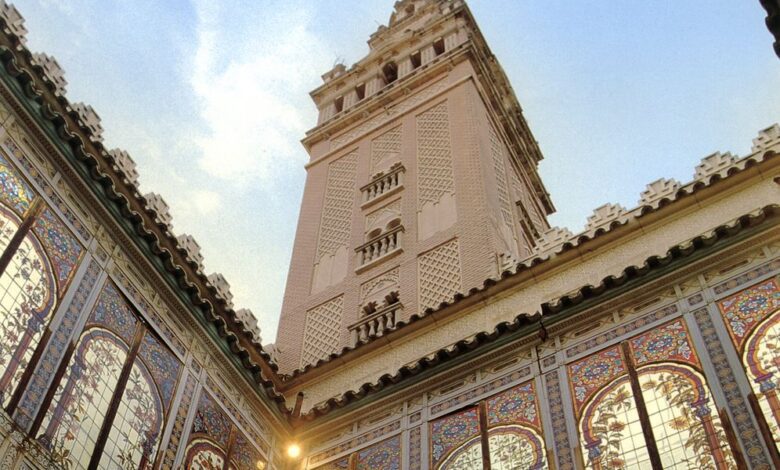
But there’s no optical illusion here. This tower, a near-perfect twin of the Giralda of Sevilla, stands proudly in the town of l’Arboç, in the province of Tarragona. Its story isn’t about a state project, but the result of a romantic journey. In the early 20th century, local resident Joan Roquer i Marí spent his honeymoon in Andalusia with his wife. He was so captivated by Moorish architecture that, upon returning home, he decided to recreate a piece of it on his own land. That’s how the idea was born—not just for a tower, but an entire palatial complex in neo-Arabic style.
Completed in 1908 under the personal supervision of Roquer, the construction impresses with its meticulous detail. The 52-meter tower, now a symbol of l’Arboç, is just the tip of the iceberg. Inside, the complex conceals exact replicas of other Andalusian gems: visitors can stroll through a courtyard inspired by the Patio de los Leones in the Granada Alhambra or admire a hall modeled after the Hall of Ambassadors in the Seville Alcázar. This isn’t just a free interpretation, but a painstaking reconstruction based on photographs brought back from that very trip. Horseshoe arches, intricate arabesques, and geometric patterns create a complete illusion of being transported to the era of Al-Andalus.
You can’t simply walk into this private palace from the street. Visits are only possible by advance reservation and are offered as one-hour guided tours. This format allows visitors not only to take beautiful photos, but also to truly understand the creator’s vision and the history of this remarkable place. For groups of more than 20 people, admission is 10 euros per person, while children under six enjoy free entry. All bookings are coordinated through the local tourist office, which helps organize the groups.
Nevertheless, the town of l’Arboç itself is equally worth exploring. It’s often called the ‘village of beautiful houses’ for a reason. A walk through its old streets fully justifies the nickname. Here, in a modernist-style building, you’ll find not only the tourist office but also the Lace Museum, dedicated to bobbin lace-making—a craft deeply rooted in local culture and recognized as unique to Catalonia. A trip here is a wonderful way to discover both a remarkable architectural gem and the quiet charm of a Catalan town.
RUSSPAIN.COM reports that the Giralda de l’Arboç, officially recognized as a Cultural Asset of Local Interest (Bé Cultural d’Interès Local), is much more than a tourist attraction. It stands as a testament to human dreams and a love for art. Joan Roquer Marí was not a professional architect, yet his passion brought to life a unique landmark that continues to amaze and inspire visitors a century later. This palace has become an intrinsic part of l’Arboç’s identity, proving that great creations can be born from personal stories.