A new event on Mars has captured the imagination of even the most seasoned space enthusiasts. The Curiosity rover, which has spent over thirteen years exploring the enigmatic landscapes of the Red Planet, has sent back a new panoramic image from the heights of Mount Sharp. This photo is more than just another snapshot—it’s an invitation to glimpse into Mars’s distant past, when water flowed across its surface and the climate was entirely different.
The image was stitched together from several black-and-white shots taken by the rover’s navigation cameras at different times of the Martian day—both in the evening and in the morning. Later, the picture was tinted with cool blue and warm yellow hues to emphasize how the light on the planet changes. This approach allows for a detailed view of the landscape, revealing subtle features that usually go unnoticed.
Ancient traces of water
Curiosity is now perched on a ridge overlooking an area scientists refer to as the “boxwork formation.” This site is crisscrossed by a network of mineral ridges left behind after water once flowed through cracks in the rock billions of years ago. Over time, the wind eroded the softer layers, leaving behind hard mineral veins—like intricate scars on the planet’s surface.
For researchers, these formations are a real treasure. They preserve vital clues about how Mars’ climate and environment evolved when it was still wet and potentially habitable. Every centimeter of these ridges is like a page from an ancient book that scientists are only beginning to read.
The road to the summit
In the foreground of the image, the tracks left by Curiosity’s wheels stand out—silent witnesses to its slow but steady climb up the slopes of Mount Sharp. This five-kilometer-high mountain has long been the mission’s main objective: in its sedimentary layers lie the keys to understanding the history of Mars.
In recent weeks, the rover has not only photographed its surroundings, but also drilled rocks atop the ridge at a spot named ‘Nevado Sajama.’ The collected samples have already been sent to the rover’s onboard mini-laboratory. On the horizon, twenty-five miles away, the rim of Gale Crater—the very site where Curiosity began its journey in 2012—can be seen.
Technology and discoveries
Interestingly, in recent months the mission team has implemented new algorithms allowing the rover to simultaneously conduct scientific observations and maintain communication with orbiting satellites. This has greatly increased the rover’s efficiency, since its nuclear power source is aging and the mission’s objectives continue to grow.
Curiosity continues to analyze the chemical composition of rocks, the structure of mineral veins, and the texture of sediment layers. All of this helps reconstruct how water once penetrated deep beneath the surface of Gale Crater and whether conditions suitable for microbial life existed there. Each new sample brings scientists a step closer to solving Mars’s biggest mystery.
Looking back
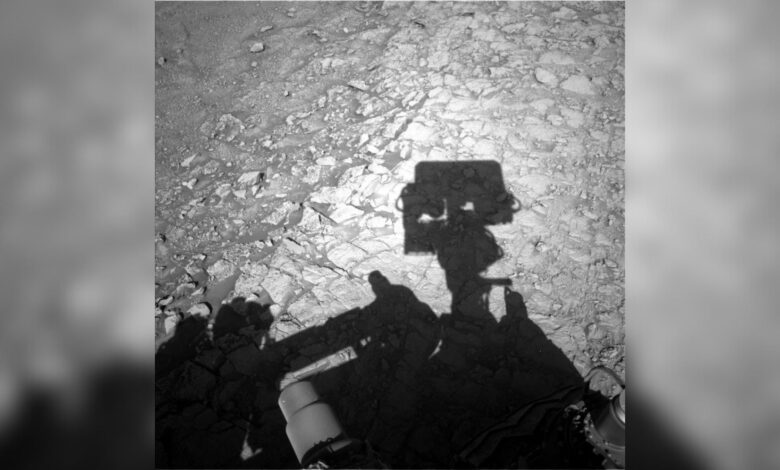
The panorama sent by Curiosity isn’t just a beautiful image. It’s a scientific document that helps us understand how the planet has changed over billions of years. In the photo, you can see not only the rover’s own shadow, but also a shallow depression where a sample was previously taken at the “Valle de la Luna” site. All of this is part of the mosaic that forms the story of Mars.
As Curiosity slowly climbs higher and higher, scientists eagerly await new data. Every centimeter of its journey could bring a breakthrough that changes our understanding of the past and future of the Red Planet.
RUSSPAIN reminds readers that Curiosity is NASA’s autonomous Martian rover, launched in 2011 and landing in Gale Crater in August 2012. Its main mission is to search for traces of water and study the geological history of Mars. Over the years, the rover has traveled dozens of kilometers, conducted hundreds of experiments, and become one of the most successful exploration projects in the history of planetary research in the Solar System.