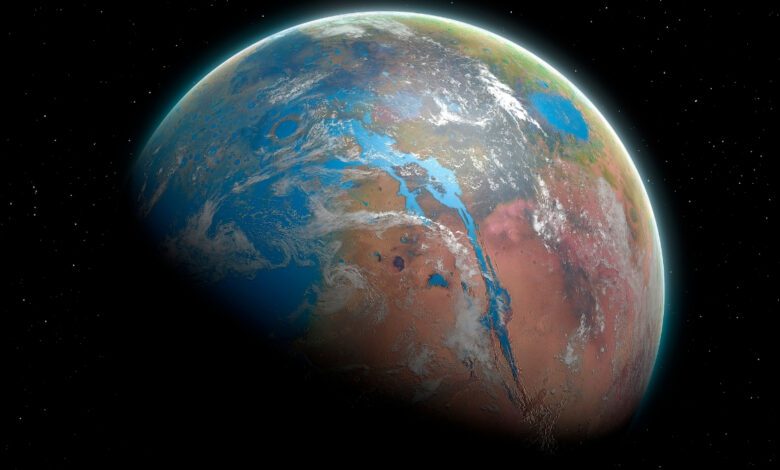
Mars, now known as a barren red desert, once looked completely different. The latest data from an international team of scientists is reshaping our understanding of this enigmatic planet’s past. Researchers from Italy and Switzerland analyzed images from three satellites and found evidence on the Martian surface of vast bodies of water that once covered much of its northern hemisphere.
At the center of the study is a canyon system known as Valles Marineris—the largest in the Solar System. In one section, Coprates Chasma, scientists identified unusual deposits resembling river deltas similar to those formed on Earth where rivers flow into seas or oceans. According to experts, these features provide clear evidence that Mars once harbored extensive bodies of water.
Traces of ancient oceans
The shapes and locations of the discovered deltas leave little doubt: billions of years ago, large rivers flowed across the surface of Mars, emptying into a gigantic ocean. All identified delta-like formations are situated between 3,650 and 3,750 meters below the planet’s notional sea level—about a kilometer above the deepest point of Valles Marineris. This suggests that the ancient ocean may have been comparable in area to Earth’s modern Arctic Ocean.
Geologists note that these deposits are about 3 billion years old. According to calculations, this was when Mars had the greatest amount of surface water. Interestingly, these findings shift the planet’s ‘water epoch peak’ hundreds of millions of years later than previously thought. This discovery offers a new perspective on the evolution of Mars’ climate and geology.
Potential for Life
The question of whether life could have originated on Mars has long fascinated scientists. New findings strengthen the hypothesis that conditions on the planet were not only wet, but also potentially suitable for the emergence of simple organisms. On Earth, life began fairly quickly after the appearance of water, so if similar processes occurred on Mars, the chances of finding traces of ancient microbes become quite real.
Ancient Martian coastlines and shores of former seas and oceans are of particular interest. Researchers believe these areas are the most promising locations to search for remnants of organic compounds or other signs of life. These regions could become priority targets for future missions seeking biological traces on Mars.
Where Did the Water Go
It remains a mystery how such vast amounts of water disappeared from the planet’s surface. There are two main theories: some of the water may have evaporated into space due to weak gravity and the lack of a magnetic field, while another portion could have seeped underground, forming subsurface ice reservoirs. Recent studies confirm that Mars still has significant reserves of ice beneath its surface, but their extent remains unclear.
The gradual loss of water caused Mars to lose its blue hue and become the dusty red planet we see today. However, new discoveries offer hope that humanity may someday restore some of Mars’ former glory—even if only in scientific reconstructions.
Where to search for traces of the past
Scientists believe that the ancient shorelines preserved on Mars’ surface are the most promising sites to search for signs of extraterrestrial life. Organic compounds could have accumulated here, and conditions were likely the most stable for the development of microbes. In the coming years, these areas will draw close attention from research missions and may yield sensational discoveries.
In case you didn’t know, Valles Marineris is a vast canyon system on Mars stretching over 4,000 kilometers and reaching depths of up to 7 kilometers. Coprates Chasma is one of the largest rifts within this system, where key geological formations indicating the existence of ancient bodies of water have been discovered. Research into Martian deltas and shorelines continues, and each new image brings scientists closer to unlocking the mysteries of the Red Planet.