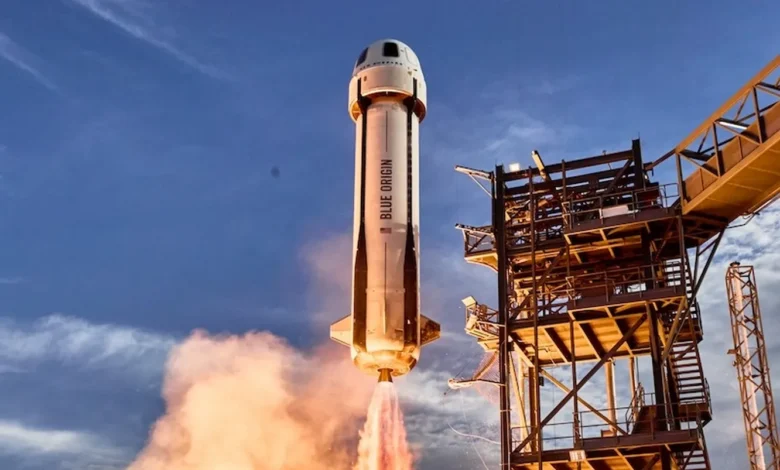
In June 2025, Blue Origin took another step forward in the development of space tourism and inclusivity. On the company’s sixteenth crewed launch, the New Shepard rocket carried Mikaela Benthaus—a German engineer who uses a wheelchair—on a suborbital flight. This mission made history as the first time a person with paralysis of both legs joined the crew of a commercial spacecraft.
Mikaela Benthaus is an expert in aeronautics and mechatronics, working at the European Space Agency. Seven years ago, she suffered a severe spinal cord injury, but did not give up her dream of space. Since then, she has continued her research work, become active in sports, and advocated for equal rights for people with disabilities in space exploration. Preparation for the flight took several years: Mikaela trained in zero-gravity conditions and practiced spacecraft operations on simulators.
Before the launch, she spoke to journalists about her emotions, emphasizing that her journey was not only a personal victory but also an important message to millions of people worldwide. According to Mikaela, she wanted to show that physical limitations do not prevent dreams of space from coming true, provided there is support and modern technology.
New Shepard flight
The New Shepard rocket, developed by Blue Origin, is designed for suborbital flights and carries its crew above the Kármán line—the conventional boundary of space at an altitude of 100 kilometers. During the NS-37 mission, six people were on board, including Mikaela Benthaus. Other participants included physicist and investor Joel Hyde, former SpaceX and Blue Origin engineer Hans Koenigsmann, as well as three more representatives from the engineering and investment communities.
The flight lasts about 10-12 minutes, during which passengers experience microgravity and can view the Earth through the capsule’s windows. After completing the suborbital segment, the crew capsule returns to the surface using a parachute system. For Mikaela and the entire team, this flight was not only a technological achievement but also a symbol of new opportunities for people with disabilities.
Inclusion in Space
Mikaela Benthaus’ participation in the Blue Origin mission marked an important milestone for the global community. Until now, no space company had ever sent a wheelchair user into space. Blue Origin not only provided the necessary safety and comfort measures for Mikaela, but also demonstrated that space is open to everyone, regardless of physical abilities.
This move could mark the beginning of a new era in space tourism and professional missions. Discussions are already underway to create specialized training programs for people with various disabilities. Experts note that Mikaela’s experience will help adapt equipment and procedures for future flights, making them more accessible to a wider audience.
The Future of Spaceflight
The NS-37 flight sparked widespread debate in scientific and public circles. Many see this event as not only a technological breakthrough but also an important step toward social justice. The coming years are expected to bring more inclusive missions, along with new initiatives to support people with disabilities in the aerospace industry.
Blue Origin continues to develop its projects, focusing on safety, innovation, and expanding opportunities for anyone who wants to experience weightlessness. The company has already announced new flights that will be open to participants of various professions and ages.
In case you didn’t know, Blue Origin is a private aerospace company founded by Jeff Bezos in 2000. The brand’s main goal is to make space travel accessible to the general public. The New Shepard rocket is named after the first American astronaut, Alan Shepard. In recent years, Blue Origin has carried out more than a dozen successful crewed launches, with Jeff Bezos himself participating in one of the first flights. The company actively competes with other industry leaders, such as SpaceX and Virgin Galactic, and continues to drive innovation in the field of suborbital and orbital flights.