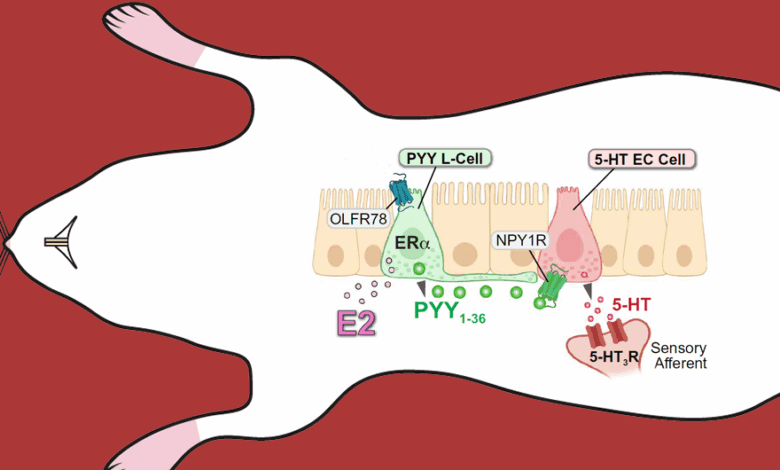
A heated scientific debate has erupted in Spanish laboratories: why do women experience chronic intestinal pain more often? A new experiment on mice has shed light on this question, revealing that estrogens can intensify pain sensations. Research conducted in 2025 found that female sex hormones activate special cells in the gut, leading to a release of serotonin and, as a result, increased transmission of pain signals.
During the study, scientists compared the intestinal response to mechanical stimulation in male and female mice. It turned out that the pain response in females was significantly higher. Moreover, when some females had their ovaries removed to eliminate the influence of estrogens, their sensitivity to pain noticeably decreased. This led researchers to suggest that estrogens play a key role in the development of pain syndromes in women.
Hormones and cells
The study paid special attention to enteroendocrine cells, which are responsible for producing serotonin. This neurotransmitter has long been recognized for its ability to intensify pain by transmitting signals from the gut to the brain. However, it turned out that estrogens do not act directly on these cells. Instead, they activate another type of cell — L-cells, which release peptide YY. As experiments showed, it is this peptide that can boost the release of serotonin by enterochromaffin cells.
When mice with removed ovaries were injected with peptide YY, their intestines once again became sensitive to pain. This discovery was a true breakthrough, revealing that female hormones can indirectly influence pain perception through a complex chain of cellular interactions. This mechanism helps explain why women are more likely to suffer from irritable bowel syndrome and other chronic abdominal pain.
New Horizons
The results of the experiment sparked significant interest among gastroenterologists and endocrinologists in Spain. It is now clear why the intensity of pain in women can vary depending on the phase of the menstrual cycle. Doctors note that such discoveries could lead to new approaches to treating chronic pain that take into account the patient’s gender and hormonal status.
However, researchers emphasize that it is too early to conclude that the same mechanism operates in humans. Additional clinical trials are necessary to confirm these findings. Nonetheless, it is already clear that pain treatment strategies should be personalized, taking into account the unique characteristics of the female body.
Advantages of the Female Immune System
Interestingly, in some cases, the female body proves to be more resilient to infections. Experiments have shown that female mice cope better with bacterial infections such as Streptococcus pneumoniae. This is due to increased activity of macrophages—immune cells that more effectively destroy bacteria in females.
It’s a paradox: on one hand, women are more likely to suffer from chronic pain, but on the other, their immune systems are better equipped to fight dangerous infections. Scientists believe these differences are linked to the effects of estrogen on various body systems, and further research will help uncover new details about this complex interaction.
A look into the future
The discovery by Spanish researchers has already sparked discussion in the medical community. Large-scale studies on humans are planned in the coming years to determine how applicable these findings are to patients with chronic intestinal pain. Doctors hope this new knowledge will enable the development of personalized treatment plans that take into account not only the diagnosis but also the patient’s sex and hormonal profile.
For now, experts advise women suffering from abdominal pain not to ignore their symptoms and to seek medical attention. There is hope that new medications to alleviate the suffering of millions of female patients worldwide will soon appear.
If you didn’t know, Holly A. Ingraham is a leading expert in neuroendocrinology, working at the University of California, San Francisco. Her team studies the effects of hormones on various body systems, including the nervous and digestive systems. In recent years, Ingraham has authored a number of significant discoveries that have changed approaches to treating chronic pain syndromes. Her research has been recognized by the scientific community and repeatedly honored with prestigious awards.