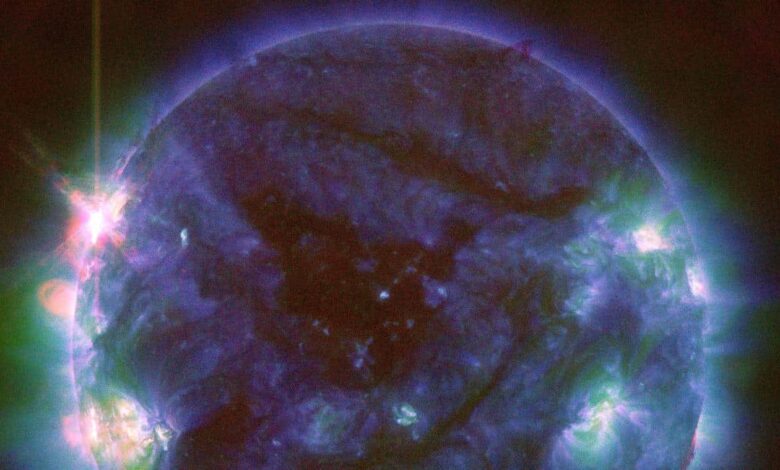
In early December 2025, astronomers observed an X1.9-class solar flare in the Sun’s northern hemisphere. This event took experts by surprise, as their attention had been focused on a massive cluster of sunspots in the south. Typically, large areas are considered the most likely sources of powerful energy bursts, but this time things turned out differently.
Sunspots are areas of lower temperature that appear due to complex processes in the Sun’s magnetic field. Their emergence always signals increased solar activity, and therefore a higher risk of flares that can affect technology on Earth. The X1.9 flare registered on December 1 caused radio disruptions in Australia and Southeast Asia, once again highlighting how space weather can impact daily life.
An unexpected scenario
Interestingly, such a powerful eruption did not occur in the largest sunspot group, but in a relatively small region numbered 4299. According to Sergei Bogachev, head of the Laboratory of Solar Astronomy at IKI RAN, it can take several days for energy to build up for flares of this scale. This time, the process took place in a decaying region, creating the illusion of a mystery: why did such a strong event occur where no one expected it?
Meanwhile, in the Sun’s southern hemisphere, a massive cluster of sunspots has been observed, divided into two regions—4296 and 4294. According to NOAA experts, their appearance has significantly increased the likelihood of new high-class solar flares. However, despite their impressive size, these sunspots have not yet triggered any major events.
Giants on the Surface
The scale of the southern group is astonishing: the region stretches up to 180,000 kilometers, and each sunspot is several times larger than the diameter of Earth. In terms of area, they have nearly matched the historic group that caused the famous 1859 geomagnetic storm, when auroras were seen even in the tropics and telegraph systems around the world were disrupted.
Today’s civilization is far more vulnerable to such events. Modern power grids, pipelines, and satellites could suffer from powerful solar energy bursts. Nevertheless, even such massive sunspots do not guarantee a superflares—special conditions and the accumulation of energy in the star’s magnetic structures are required.
Awaiting New Developments
Experts say that predicting major solar flares is extremely difficult. Even with huge sunspots on the Sun’s surface, an outburst may never happen—or could occur at the most unexpected moment. Scientists are closely monitoring the situation, noting that the southern group of sunspots has reached record sizes but remains relatively calm for now.
In the summer of 2025, the Sun reached the peak of its 11-year activity cycle. The number of sunspots is gradually decreasing, but the likelihood of powerful solar flares remains. For geomagnetic storms to occur on Earth, not only sunspots are needed, but also a directed plasma ejection. For now, scientists can only monitor the changes and hope that any potential flares are not directed toward our planet.
If you weren’t aware, NASA (National Aeronautics and Space Administration) is the leading American agency conducting space research and developing space technologies. The Solar Dynamics Observatory is one of NASA’s flagship projects, providing unique data about processes on the Sun. Thanks to these observations, scientists around the world can promptly track changes in solar activity and assess potential risks for Earth.