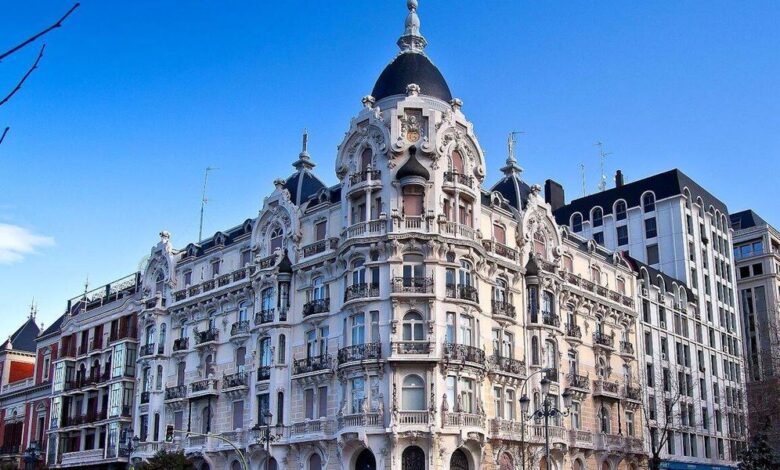
Opposite Madrid’s Plaza de España stands one of the city’s few Art Nouveau buildings—the Casa Gallardo. Its snow-white, almost fluid façade crowned with a slate dome has dominated this neighborhood’s architecture for over a century. Since 1997, it has been officially recognized as a Site of Cultural Interest. At first glance, it could be mistaken for a French mansion or even a whimsical fantasy from the Baroque era. Yet behind this elegant exterior lies one of the most remarkable works of architect Federico Arias Rey. Built in 1914 on the foundations of an older structure from the 1850s, the building masterfully blends the expressive freedom of Art Nouveau with the technical precision typical of early 20th-century Madrid architecture.
Sculpture Instead of Walls
Located at 2 Ferras Street, this building stands out thanks to its sculptural façade, flowing curves, and a wealth of decorative elements that lend it an almost theatrical appearance. Its wrought-iron balconies, detailed moldings, and the way the light plays on the pale stone surface evoke a time when architecture aspired to become an all-encompassing art form. The grand dome crowning the building’s corner is adorned with the letter ‘G’—a tribute to its first owners, sisters Esperanza and Asunción Gallardo, who played a key role in preserving this treasure. Just a year after construction was completed, Madrid City Hall awarded the project the 1915 prize for ‘Best Constructed Building,’ confirming its exceptional value. Today, it remains one of the capital’s rare surviving examples of Art Nouveau, alongside masterpieces like Palacio Longoria and Cine Doré.
Japanese harmony in a century-old mansion
Beyond its historical value, Casa Gallardo today is home to the LeClab restaurant, led by Japanese chef Yoko Hasei. The venue blends the elegance of the old building with the kaiseki dining concept, rooted in the harmony of five colors, five flavors, and five cooking techniques. Signature dishes include unique creations such as tuna tataki, Wagyu gyoza, and a delicate seasonal miso soup. All of this is served in an atmosphere that preserves the grandeur of the Roaring Twenties. The more than 400-square-meter interior has retained the spirit of the historic mansion: high ceilings, original stucco, and details that all tell their own stories. 17th-century tapestries, antique furniture, and a grand piano recall the era of literary salons. Every element turns this place into a living monument, where architecture, history, and gastronomy merge against one of the most beautiful views of central Madrid.
A journey through time: from Art Nouveau to burlesque
LeClab is also known for organizing private parties and events with a unique concept. Guests are treated to a refined and elegant evening inspired by early 20th-century burlesque, transporting them to another era. The show blends luxury and the decadent glamour of Hollywood’s Golden Age. The artistic director is the world-renowned performer LadyVita (Patricia Morote), with coordination managed by Luisa Orlando. Even today, Casa Gallardo makes passersby stop and look up, witnessing how Madrid’s modernist architecture—though not the city’s most common style—has left here one of its most sophisticated and timeless masterpieces. Its grand and serene presence, facing Plaza de España, stands as a reminder that architectural beauty can be a form of resistance against the passage of time.