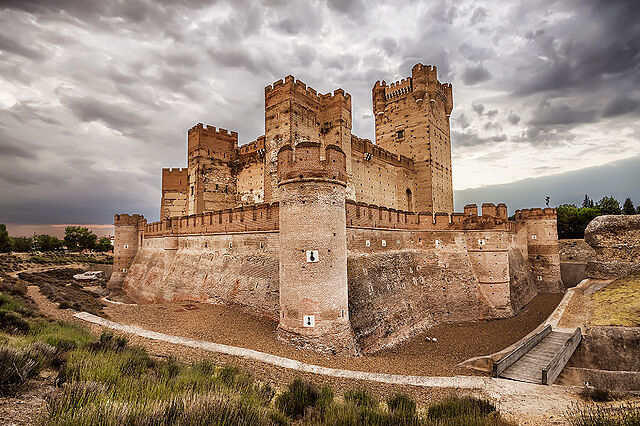
On the endless plains of Castilla y León, in the town of Medina del Campo, rises a monumental red brick structure whose silhouette inevitably evokes images from magical sagas. This is the Castle of La Mota, one of Spain’s most impressive and historically significant strongholds. Its massive walls and majestic donjon tower transport travelers five centuries back in time, to an era of knights, royal intrigues, and great upheavals. The structure, which today attracts thousands of tourists, was more than just a fortress: it served as a political center, the royal treasury, and a prison for some of the most prominent figures of its time.
The Impregnable Bastion of Castile
The history of the castle dates back to the 15th century, during the reign of Juan II of Castile. It was under his orders that construction of the citadel began, ultimately completed by his successor, Enrique IV. However, La Mota acquired its formidable final appearance thanks to the Catholic Monarchs, Isabel and Ferdinand. Recognizing the changing nature of warfare, they ordered the modernization of the castle, turning it into a model of advanced military engineering. A massive artillery barrier wall and a deep moat were built around the fortress, making it nearly invulnerable to the siege weapons of the time. This innovative defense system became a benchmark for all of Europe, showcasing the military might of a unified Spain. Within its walls was not only a garrison, but also one of the kingdom’s most important institutions—the Archive of the Castilian Crown, where valuable documents and treasures were kept.
A prison for nobles and geniuses
The mighty walls of La Mota served not only for protection but also for isolation. The castle quickly gained a reputation as an elite prison, where not common criminals but political opponents, disgraced aristocrats, and captured commanders were held. Hernando Pizarro, brother of the famed conquistador, spent twenty years imprisoned here, convicted of murder. But the most legendary story linked to the castle’s days as a prison is that of Cesare Borgia. The son of Pope Alexander VI, notorious for his cruelty and ambition, was captured and brought to La Mota. Escape from the 40-meter-high tower seemed impossible. However, Cesare, showing remarkable cunning, managed to orchestrate a daring escape. With the help of his allies, he descended the dizzying height on a rope, broke his leg in the fall, but nevertheless managed to evade pursuit and leave Spain. This episode only added to the castle’s aura of mystery and impregnability.
The Tragedy of Queen Juana
However, the saddest chapter in the castle’s history is linked to Juana I of Castile, known to the people as ‘la Loca.’ The heir to the Catholic Monarchs, she became a pawn in cruel political games. Her own mother, Queen Isabella, ordered her to be confined in La Mota—officially due to her pathological jealousy of her husband, Philip the Handsome, and alleged signs of mental illness. Juana spent two years in the castle, deprived of her freedom and the chance to see her husband. After his sudden death, her grief knew no bounds, and this deep depression was exploited by her father, Ferdinand, and later her son, Charles V, to permanently remove her from the throne to which she had every legitimate right. Juana’s story is not merely a tale of madness, but a tragedy of a woman whose feelings and rights were sacrificed for state interests.
A journey into the past today
In 1904, La Mota Castle was declared a National Monument, saving it from destruction and oblivion. Today, it serves as a cultural center and museum, open to anyone who wishes to explore its history. Visitors can freely and at no cost stroll through the outer courtyard, view the chapel, and visit the Hall of Juan de la Cosa on the ground floor. This offers a sense of the scale and atmosphere of the site. For those wanting a deeper dive into the past, guided tours are available for a fee. A guide will lead you through Iron Age archaeological excavations, show the underground shooting galleries, and take you through the inner chambers. The highlight of the visit can be climbing the 40-meter Torra del Homenaje. After ascending 160 steps, you’ll arrive at the Hall of Honor, the Queen’s chambers, and the viewing platform, which offers a breathtaking panorama of the Castilian lands. On certain days, theatrical performances are even held here, bringing to life the legends of the ancient fortress.