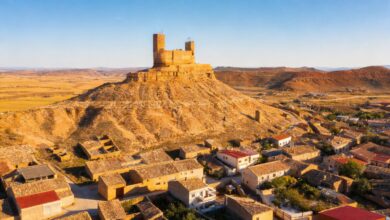
In the province of Segovia, far from the bustling tourist routes, lies the small town of Coca. Despite its modest size and a population of less than two thousand, this place preserves the legacy of two great eras—the Roman Empire and medieval Spain—making it a unique destination for travelers.
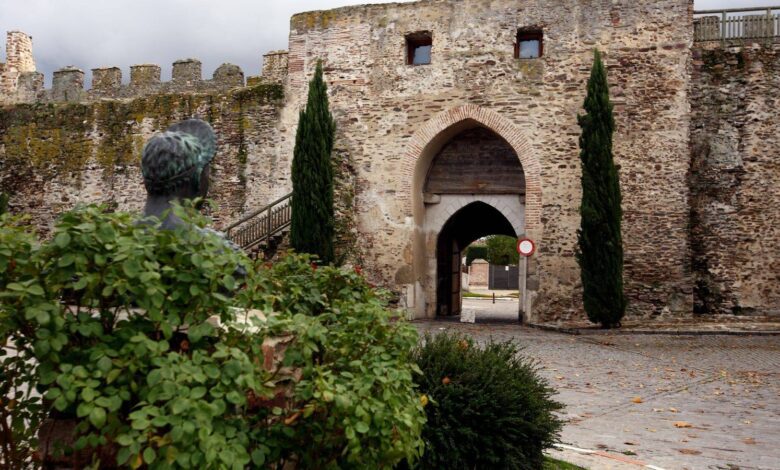
It was here, in the ancient settlement known as Cauca (Cauca), that Theodosius I the Great was born in the 4th century. He was destined to become the last ruler to govern the entire Roman Empire before its final division into Western and Eastern regions. Theodosius also went down in history as the emperor who established Christianity as the official religion. He is one of three emperors of Spanish origin, along with Trajan and Hadrian, and a commemorative bust in his honor stands in the town.
However, the main attraction that draws travelers to Coca today is its magnificent castle. The Castle of Coca (Castillo de Coca) is an outstanding example of military architecture in the Gothic-Mudejar style, built at the end of the 15th century by order of Archbishop Alonso de Fonseca. Its uniqueness lies in its material—it is constructed almost entirely of brick, which was unusual for defensive structures of that time. Massive walls, polygonal towers, and the skillful use of brickwork as a decorative element make the castle one of the most impressive and best-preserved in Spain.
A visit to Coca is not just a journey into history. The town is surrounded by the picturesque landscapes of the Tierra de Pinares region, known for its pine forests. Tourists can stroll through its ancient streets and then discover the local gastronomy. Among the traditional dishes, the famous roast suckling pig (cochinillo asado) stands out, while for dessert, visitors can try sweets with pine nuts (empiñonadas).
Thus, Coca offers a unique blend of historical heritage, architectural masterpieces, and culinary traditions, making it a must-visit destination for anyone interested in Spain’s rich and diverse history.