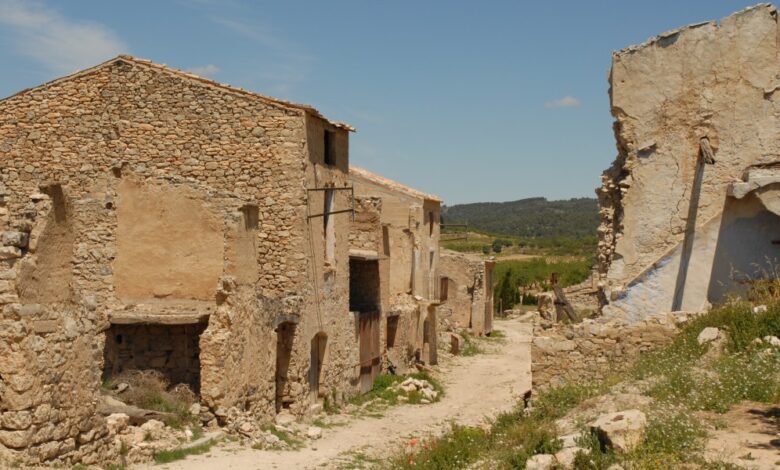
The lost villages of Tarragona are more than just forgotten dots on the map—they are silent witnesses to changes that reshaped all of Catalonia. Their disappearance resulted not only from economic hardship but also from historical disasters that forever altered the lives of local residents. Today, the ruins of these settlements evoke anxiety in some, curiosity in others, and inspire a desire to understand how quickly an entire world can vanish.
Among the region’s most famous abandoned places is La Mussara. This settlement, hidden atop a mountain, is often shrouded in thick fog. The ruins of its church and stone houses recall a time when life once thrived here. However, a phylloxera epidemic and chronic water shortages forced people to leave their homes. By the 1960s, the village was deserted, and its ominous reputation grew, fueled by tales of supernatural phenomena and local legends.
A similar fate befell Poble Vell de Corbera d’Ebre, though in this case it was not economic decline but the horrors of the civil war to blame. In 1938, the town lay at the heart of fierce battles, and after devastating bombings, residents chose to build a new settlement at the foot of the hill. Today, the ruins and the partially destroyed church are reminders of that tragic past and have become a place of memory for all of Catalonia.
Causes of disappearance
Gallicant, perched on the slope above the Siurana river valley, was once a small agricultural community. The lack of electricity, constant water shortages, and isolation made life here unbearable. Even the establishment of a nearby military camp could not stop the exodus. By the 1960s, the village was completely deserted, and its houses became silent monuments to a bygone era.
Selma, in the Alt Camp region, preserves traces of medieval history. The rule of the Templar Order, followed by a series of agricultural crises and improved roads to larger towns, led to the gradual extinction of the settlement. By the early 20th century, few people lived here, and today only the remains of buildings and a bell tower remain.
Fonscaldetes, on the slope of the Serra Voltorera, was a tiny village that was home to about thirty people in the 1930s. The lack of basic amenities—electricity, water, a school, and medical care—sped up the departure of residents. The last family left in 1964. In recent years, local enthusiasts have tried to restore the church and tidy up the surroundings, but bringing life back to these places is already impossible.
Life on the edge
Marmellar, in the Baix Penedès area, was surrounded by farms and relied on rainwater and wells. Harsh conditions and lack of infrastructure forced families to move to more comfortable locations. By 1958, not a single resident remained. Despite gloomy rumors about the village in later years, Marmellar was a typical rural settlement where people struggled to survive.
Montargull, in Conca de Barberà, once even had its own castle, but by the mid-20th century, residents had moved to a neighboring town due to a lack of resources. Electricity and a road arrived too late to stop the population exodus. By the end of the 1960s, the village was deserted, and its houses became part of the local landscape.
Pinyeres, in Terra Alta, was remote from major cities, making every shopping trip a real challenge. Olive groves, grain, and sheep were the main sources of income. After the severe frosts of 1954 and due to the lack of infrastructure, residents finally left the village in 1973.
Memory and new meanings
The abandoned villages of Tarragona have become of interest today not only for history enthusiasts, but also for those looking for unique routes through Catalonia. Their ruins are a reminder of how quickly a familiar way of life can disappear. In some places, enthusiasts are trying to preserve the remaining structures so that future generations can see how their ancestors lived.
Interestingly, Catalonia is home to other unique places where the past comes alive in extraordinary ways. For example, in one of the region’s forests, you’ll find a remarkable nativity scene featuring a hundred miniature sculptures, including replicas of works by Gaudí and Dalí. You can learn more about this unusual spot in our story about Catalonia’s enchanting Christmas forest.
As Idealista reports, the fate of these villages is a vivid reminder that even the most picturesque places can become deserted if the conditions for living disappear. The question of preserving such locations is becoming ever more urgent, as they are part of the region’s cultural heritage.
Throughout Catalonia’s history, there have been times when entire settlements vanished from the map. For example, after the phylloxera epidemic in the 19th century, many wine-growing villages were abandoned and their residents moved to the cities. A similar fate befell some communities in other parts of Spain, where economic and natural disasters triggered mass exoduses. These examples show how fragile rural life can be, and why remembering such places is so important for understanding the country’s past and present.