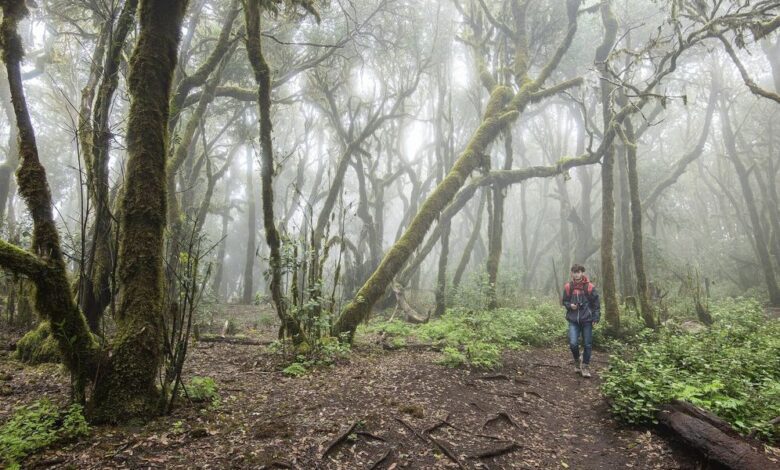
In the heart of the small Canary Island of La Gomera lies a world that seems frozen in time. This is not just a park, but an entire ecosystem shrouded in an almost constant milky veil of mist. The air here is saturated with moisture and the scent of damp earth, broken only by the rustling leaves and the song of unseen birds. When you enter, you leave behind the bustle of the modern world and immerse yourself in an ancient landscape, unchanged for millions of years. This is Garajonay—La Gomera’s green heart, a place of power and mystery, recognized as a treasure of all humanity.
A living fossil from the Tertiary period
What makes this place truly unique is its flora. The local thickets are laurel forests, or laurisilva, which in the Tertiary period once covered much of southern Europe and northern Africa. Glacial eras wiped them out almost everywhere, but here in the Canary Islands, thanks to a unique microclimate, they have survived in their original form. Their secret to survival: the trade winds. These constant breezes bring moist air masses from the Atlantic, which, upon colliding with the mountains of La Gomera, create the famous “sea of clouds.” This ever-present mist condenses on the leaves, producing a phenomenon known as “horizontal rain.” It’s this moisture that nourishes the giant laurels, heathers, yews and dozens of other plant species, many of which can’t be found anywhere else on the planet. The dense woodlands, draped in mosses and lichen, are also home to unique wildlife, including the rare endemic pigeons—the turqué and the rabiche—whose cooing adds an air of mystery to the landscape.
Along the trails of ancient legends
The park covers more than a tenth of the island’s total area, and its highest point, Garajonay Peak, rises to 1,487 meters above sea level. On a clear day, the summit offers breathtaking views of rugged slopes carved by deep ravines descending to the ocean, and even silhouettes of the neighboring islands—Tenerife, El Hierro, and La Palma. The park’s very name is steeped in a romantic and tragic legend about the lovers Gara, a princess from Gomera, and Jonay, a young man from Tenerife. Their love was forbidden, and as they fled from their pursuers, they chose death over separation by leaping from the highest cliff. This story still lives on in local culture, giving the park a special, spiritual significance. Walking along the many marked trails here is more than just hiking—it’s a meditative journey into a fairytale, where every turn of a trail shrouded in mist feels like a place where miracles might await. You can also discover traces of the island’s ancient inhabitants and remains of old structures, such as charcoal pits and water collection channels.
A fragile world under protection
Today, this ancient oasis serves as a benchmark for nature conservation and the development of responsible tourism. Its status is confirmed by its inclusion in the Natura 2000 network, its designation as part of a Biosphere Reserve, and its holding of the European Charter for Sustainable Tourism. This ensures that the ecosystem’s delicate balance will be preserved for generations to come. Visiting this place is a chance to connect with Earth’s distant past, to feel both the power and vulnerability of nature. Dense vegetation, constant humidity, and a profound silence create one of the most mysterious and beautiful landscapes in the Canary Islands—where every step into the misty forest feels like traveling to another era, a world untouched by civilization.