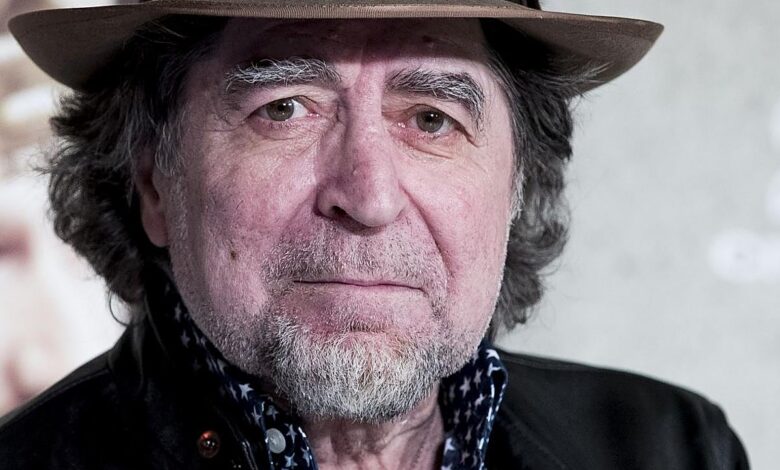
Joaquín Sabina, one of Spain’s most iconic musicians, has recently announced his retirement from the stage. Over several decades, he became not just a symbol of a musical era but also a figure whose biography is filled with unexpected turns. His life story tells how a boy from a middle-class family found himself at the heart of the country’s cultural and intellectual elite.
Sabina was born into a family where his father, Jerónimo Martínez Gallego, served in the police force, while his mother, Adela Sabina del Campo, managed the household. Despite a strict outward appearance, a creative spirit always filled their home: his father wrote poetry and stories, and his mother, who came from an impoverished aristocratic family in Huelva, retained an air of former luxury and discipline. A special place in the future artist’s life was held by his grandfather, whose photograph Sabina still keeps as a family heirloom.
Family relationships were complicated. His mother and grandfather often argued, and his parents’ views were quite conservative. Sabina never hid that his mother held far-right beliefs, while his father, despite being well-educated, was far from the arts. Nevertheless, it was these contradictions that became a source of inspiration and inner conflict for Joaquín, something later reflected in his songs.
The first steps
In his youth, Sabina faced serious challenges. In the late 1960s, during Spain’s state of emergency, he became involved in an incident with the arson of a bank. Fearing consequences, he fled to his hometown of Úbeda, hoping to evade prosecution. Fate, however, took a cruel turn: it was his own father, a police officer, who received orders to arrest his son and bring him to the Granada station. This episode left a lasting mark on the musician, becoming one of the most dramatic moments of his early life.
Despite a complicated relationship with his father, Sabina always noted his kindness and intellect. After his father’s death from Alzheimer’s disease, the artist spoke warmly of him, acknowledging that while he may not have been the ideal fit for police work, he was an honest man with a gentle character.
Family influence
Sabina’s family ties are closely connected with Spain’s elite. His first wife, Isabel Oliart, gave him two daughters—Carmela and Rocío—who prefer to keep out of the spotlight. Oliart is the daughter of former minister and RTVE chief Alberto Oliart, a man notably connected to the country’s intellectual circles. Through this family, Sabina met prominent poets and writers, which deeply influenced his creative work and social circle.
Sabina’s second marriage to photographer Jimena Coronado, daughter of the former head of Peru’s Central Bank, further strengthened his ties with influential figures. However, the artist has always emphasized that his success is the result of his own efforts, not merely advantageous connections. He managed to build his career relying on talent, charisma, and an ability to connect with people from all walks of life.
Friends and Social Circle
Sabina has always been part of a bohemian milieu. His home often served as a gathering place for well-known musicians, poets, and actors. The legendary Lola Flores, for example, used to call him when she couldn’t find her son Antonio. He maintained a friendship with Antonio Muñoz Molina, who even based a character on Sabina’s father in one of his novels. These relationships not only enriched the musician’s personal life but also inspired new artistic works.
Today, Sabina can afford a life of luxury: he owns a spacious duplex in the center of Madrid and a cozy house by the coast in Rota. However, the road to this success was long and challenging. His biography exemplifies how someone from an ordinary family can join the cultural elite without losing touch with their roots.
In case you didn’t know, Joaquín Sabina is a Spanish poet, composer, and singer, born in 1949 in Úbeda. Over his career, he has released more than 15 studio albums and received numerous prestigious awards. His songs are renowned for their sharp lyrics and deep lyricism. Sabina is considered one of the most influential figures on the Spanish music scene from the late 20th to the early 21st century. In recent years, he has been actively involved in cultural projects and documentaries dedicated to the history of Spanish music.