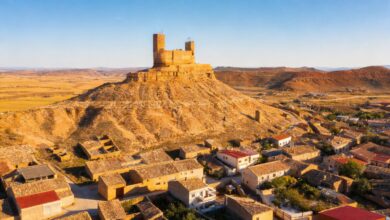
Amid the endless plains of Castile, where the horizon merges with fields of grain, lies a place seemingly frozen in time. This is Madrigal de las Altas Torres, a small town in the province of Ávila, whose name rarely appears in tourist guides—though it surely deserves mention. What makes it unique is that it’s one of the few medieval fortresses in Spain built not atop a hill or cliff, but right in the middle of a flat, table-like landscape. Majestic defensive walls made of brick in the Mudéjar style surround the historic center, inviting visitors on a journey centuries back in time.
The town’s greatest historical treasure is inextricably linked to one of Europe’s most powerful women. It was here, within the walls of the palace of Juan II—now the active monastery of Nuestra Señora de Gracia—that the future Queen of Castile and unifier of Spain, Isabella I the Catholic, was born in 1451. Visitors can walk through the very halls where the young Infanta took her first steps and feel the spirit of an era of great change, an era destined to have this land at its very heart.
The undisputed architectural highlight of the city is the church of San Nicolás de Bari. Its 65-meter bell tower, visible from miles away, serves as a beacon for travelers. The church is a magnificent example of the Romanesque-Mudejar style, and its historical significance is immense. The original baptismal font where the newborn Isabella was baptized is still preserved inside. The breathtaking coffered ceiling made of walnut wood also inspires awe. It’s no surprise that back in 1931, this building was declared a National Monument and remains a key stop on the famous route dedicated to the life of the queen.
But Madrigal is more than just the story of one queen. A stroll along its cobbled streets reveals other treasures. For instance, the Royal Hospital of the Immaculate Conception, founded in the 15th century, has been transformed today into a cultural center with exhibition halls. Its chapel houses a revered Gothic sculpture of Christ. Nearby, there’s a museum dedicated to Vasco de Quiroga, the humanist and bishop born here who left a deep mark on the history of Mexico. And the region’s rich winemaking tradition is reflected in the monumental 18th-century winery, known as Bodega de los Frailes.
Beyond the city walls, nature reveals its treasures. The local plains and marshes are home to rare birds, including great bustards, little bustards, and cranes, making the area a draw for birdwatchers and wildlife enthusiasts. Madrigal de las Altas Torres is more than just a town—it’s a living witness to pivotal moments in Spanish history. Walking its streets, exploring the ancient monastery ruins, and gazing over the endless fields from the towers all help explain why this seemingly modest place still preserves the spirit of a great era and remains one of the best kept secrets of Castilla y León.