Earrings made from natural pearls and diamonds, once owned by Maria Amalia, the wife of France’s last monarch, are back in the spotlight among collectors. They are valued at 7 million euros, highlighting not only their rarity but also their historical significance. According to russpain.com, such items with verified royal provenance rarely appear on the open market, and interest in them has been fueled by recent high-profile museum thefts.
The earrings were crafted around 1790 and have been passed down through the Orleans family for more than two centuries. Unlike other pieces of Maria Amalia’s jewelry, which were stolen from the Louvre last year, these earrings have been preserved in exceptional condition and come with full historical documentation. The stolen items included a tiara, a necklace, sapphire earrings, and jewelry belonging to other members of the French and European nobility. The only recovered piece was Empress Eugenie’s crown, which the thieves abandoned as they fled.
Royal legacy
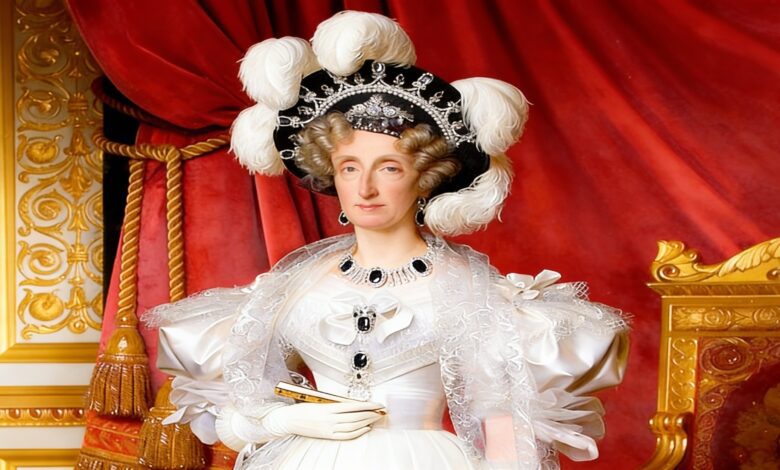
Maria Amalia was a descendant of the Bourbon and Habsburg dynasties, which gave her access to the finest jewelry of her era. The earrings up for auction are adorned with large drop-shaped saltwater pearls and old-cut diamonds. In the late 18th and early 19th centuries, such pearls were valued higher than diamonds, reflecting the tastes and traditions of European courts. The earrings were later enhanced by Mellerio, the official jeweler to the French crown, who added a diamond setting.
The piece originally belonged to Maria Amalia’s mother, Maria Carolina of Austria, and was passed down to her daughter as a family heirloom. In an 1817 portrait by François Gérard, the queen is depicted wearing these very earrings. After the monarchy fell in 1848, the earrings remained in the family’s private possession and were inherited by Maria Amalia’s son, Prince de Joinville, then by his daughter Françoise, and later by her grandson, Prince Henri. In the 20th century, the earrings appeared at significant family events, including a wedding in Palermo in 1931. After the last owner passed away in 2003, the earrings were sold to a private collector in Switzerland.
Losses and recoveries
The Mellerio earrings are one of the few surviving jewels of Maria Amalia, especially after the daring theft at the Louvre when sapphire pieces from the Apollo Gallery were stolen. Family tradition attributed the origin of this set to Marie Antoinette, but a letter from King Louis Philippe to Hortense de Beauharnais confirms that the set was acquired in 1821. All elements are adorned with Ceylon sapphires framed by diamonds and remained for a long time in the Orleans collection before being sold to the Louvre in 1985. The only tiara not given to the museum has been preserved in the family and occasionally appeared at formal events—for example, at the wedding of Prince Alexander of Yugoslavia in 1955.
Interest in the destinies of European queens and their influence on tradition and power remains strong. In this context, it is worth paying attention to material about the changes in the lives of twelve monarchs who broke with court convention— details about the destinies of European queens reveal unexpected aspects of their biographies.
Dynasties and jewels
Maria Amalia was not considered the legitimate Queen of France, yet it is her personal jewels that became a symbol of the era and family continuity. After her exile in 1848, she took some of the jewels to England, where they remained until the mid-20th century. A sapphire and pearl tiara that also belonged to Maria Amalia is still held in the collection of the Count and Countess of Paris and is regarded as one of the most valuable relics of the Orleans family.
The history of these jewels illustrates not only the shifting fortunes of European dynasties but also the complex journeys of luxury items passed down through generations. The earrings, set to be auctioned in 2026, are a rare example of a royal heirloom that survived both political upheavals and theft, making them especially appealing to collectors and historians.
Maria Amalia Bourbon-Two Sicilies was born into a family that united major European dynasties. Her mother, Maria Carolina of Austria, was the sister of Marie Antoinette, and Maria Amalia herself became the wife of Louis Philippe I, the last King of France. Her jewelry, crafted by the finest European artisans, reflected the tastes and traditions of the era, while the fate of these gems has become part of not only France’s history but also that of all Europe. The pearl and diamond earrings, having outlasted revolutions, thefts, and changes of ownership, remain today a symbol of lost grandeur and dynastic continuity.