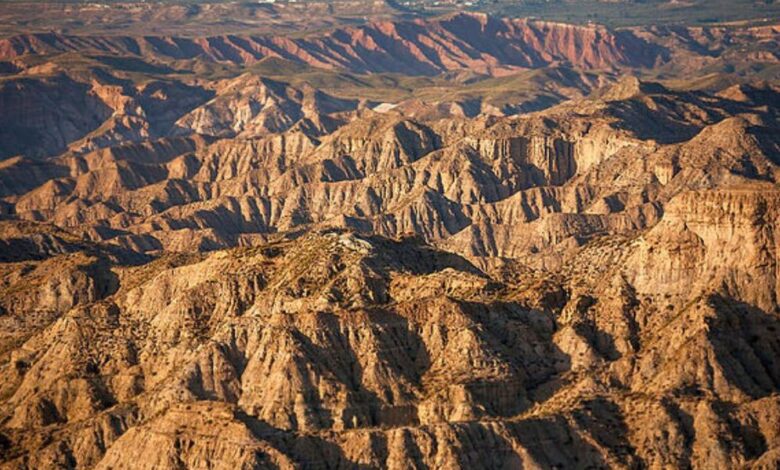
Under the scorching sun of southern Spain lie landscapes that seem otherworldly. Reddish mountains, deep ravines, and canyons carved by erosion tell the story of millions of years of geological history. This is one of the country’s most striking corners, drawing not only scientists and adventurers, but also travelers in search of unique experiences. For example, the chance to spend the night underground, just like the ancient inhabitants of these lands. You don’t have to fly to Turkey or the US to see this. These astonishing landscapes are found in Andalusia. We’re talking about the Granada Geopark, one of Europe’s most important, valued for its geological, cultural, and natural heritage.
From Mars to the Wild West—all in one province
The geopark covers more than 4,700 square kilometers, including the areas of Guadix, Huéscar, Baza, and Los Montes. This region has preserved one of the world’s best records of the Quaternary period, rich in paleontological discoveries. But its main feature is the remarkable adaptation of humans to the clay soil, which gave rise to a unique type of dwelling—the cave house. The landscapes of the Granada Geopark are often compared to Turkey’s Cappadocia for their ochre hues and fantastical shapes sculpted by wind and water. One of the most famous municipalities in this regard is Purullena, often called the “Spanish Cappadocia.” Here, many caves are still inhabited or have been turned into ethnographic museums showcasing the life of ancient troglodytes. Tourists can stay in guesthouses to experience the charm of underground living without giving up modern comforts, as well as enjoy wine tastings, guided tours, or swimming in a pool during summer.
Life underground: from ancient troglodytes to modern tourists
The cave dwellings of the geopark are more than just an architectural curiosity—they are living evidence of an ancient way of life. In towns like Guadix, Purullena, or Benalúa, these caves have served as shelters since prehistoric times, thanks to their main feature: a constant temperature of about 18-20 degrees Celsius year-round. This natural insulation is perfect against the winter chill and summer heat. During the period of Arab rule, the tradition of building cave houses was refined, and in the 15th century, after the Reconquista, they became a refuge for the Moriscos. Over time, many caves were transformed into full-fledged family homes, and today, they serve as tourist accommodation with all modern comforts: fireplaces, kitchens, Wi-Fi, and sometimes even a hot tub. Guadix, with more than 2,000 cave houses, is considered Europe’s largest troglodyte center. Its cave district is a maze of whitewashed streets and chimneys jutting straight out of the reddish earth. Here, as the locals say, the land itself embraces you.
Things to do in the ‘Spanish Cappadocia’
In addition to staying in unique homes, the region offers a wealth of activities. It’s an ideal spot for hiking, cycling, and even hot air balloon rides. One of the most popular routes is the “Great Trail of the First Settlers”—a multi-day trek through villages, dolmens, and distinctive natural areas. Another appealing option for families is the route along the Toril Aqueduct. This trail not only immerses you in nature, but also takes you past the Alicún dolmens, which are part of the largest concentration of megalithic monuments in Spain, particularly around Gorafe. In 2020, UNESCO added this park to its Global Geoparks Network, giving a boost to sustainable tourism in the area. The region’s cuisine features local vegetables, grilled meats, and wines from the Guadix comarca. Some restaurants, also tucked inside caves, serve traditional dishes like Segureño lamb or migas with sausages.