There are books that change our perception of the world, and there are places forever immortalized on their pages. In the very heart of the Iberian Peninsula, across sun-scorched plains, lies a land where the line between fiction and reality has blurred to its limit. This is a journey into the world of one of literature’s greatest works—a chance to see with your own eyes the landscapes that inspired Miguel de Cervantes to create the immortal tale of an hidalgo who fancied himself a roaming knight.
This is not just a trip through a list of landmarks but a true pilgrimage for lovers of fine literature, drawing visitors from all over the country—from bustling Catalonia to sun-soaked Andalusia—and even from abroad, such as neighboring Portugal. Here, every winding road, every ancient town, and every outline on the horizon echoes in the soul of anyone who has ever immersed themselves in the adventures of the ingenious hidalgo and his loyal squire Sancho Panza.
The journey begins and the author’s shadow
It is only logical that such a journey begins where the creator’s own heart once beat. Alcalá de Henares, a UNESCO World Heritage Site, welcomes visitors with the atmosphere of an ancient university town. It was here that the future genius of Spanish literature was born. The writer’s house-museum offers a glimpse into the life of that era, letting you imagine the surroundings in which the man who gave the world the Knight of the Sorrowful Countenance grew up. The route then leads to Esquivias, a small town in the province of Toledo. This place is closely tied to the author’s personal life: here, he met his wife, Catalina de Salazar y Palacios. Visiting Catalina’s family house-museum helps us understand not only the writer’s biography but also the social and cultural context that nourished his creativity.
In the land of giants and eternal love
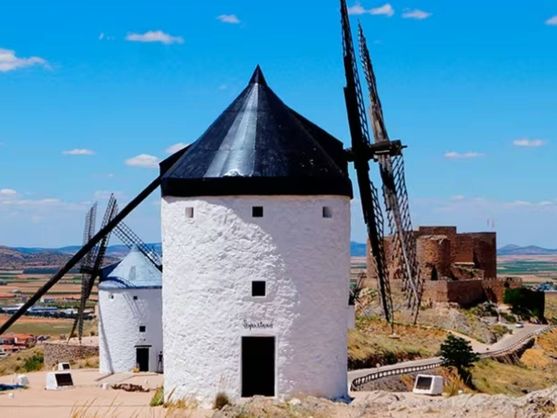
But soon the asphalt gives way to a winding road that snakes through endless fields, and on the horizon, they appear—the very giants the noble hidalgo once battled. The windmills of Consuegra and Campo de Criptana are perhaps the region’s most iconic symbol. Their white towers with imposing blades rise proudly atop the hills, creating a truly fantastic scene. Standing at the base of these structures, it’s easy to imagine a scene from the book and to feel the urge that drove the hero to charge. It’s a powerful symbol of the struggle between idealism and mundane reality. And after a battle with imaginary foes, the soul craves romance—which it finds in El Toboso. This town is immortalized as the home of Dulcinea, the knight’s lady love. Everywhere are reminders: monuments, a museum dedicated to the heroine, and even locals who proudly share their connection to the great work. The town lives this myth, weaving the literary figure into its very identity.
The depths of La Mancha and the legacy of the Golden Age
The journey continues, taking us further into the heart of the Manchegan lands. In Argamasilla de Alba, where, according to legend, the author began writing his masterpiece while imprisoned in the Cave of Medrano, one can feel the spirit of a great idea taking shape. Another significant stop is the surroundings of Ossa de Montiel, home to the famous Cave of Montesinos and the Castle of Rochafrida, which set the stage for one of the most mysterious episodes in the hero’s adventures. But this itinerary is more than just following in the footsteps of fictional characters. It is also an introduction to the region’s rich heritage. Villanueva de los Infantes, with its magnificent Renaissance and Baroque architecture, is considered one of the country’s most beautiful small towns. The highlight of the cultural program is a visit to Almagro, where the Plaza Mayor with its glass-enclosed galleries is unique. The city’s main treasure, however, is the Corral de Comedias, the only fully preserved 17th-century theater in the world, where performances are still held to this day. This is a living monument to Spain’s Golden Age, a period that gave the world not only great writers but also a unique theatrical tradition.
Ultimately, following in the footsteps of the famous knight turns out to be more than just a tourist trip. It becomes a dialogue with history, an opportunity to touch the genius of human thought and to understand why the story of a mad dreamer and his pragmatic companion continues to move people around the world more than four centuries later.